
The 2027 Guide to Agentic Social Listening Tools
Find the developer conversations and coding-agent actions that explain why people choose, struggle with or recommend your product. Turn that evidence into resolved blockers, better evaluations and stronger community programs.
In this article
Takeaways
- Technical listening includes code and conversation. Track package names, errors and integration attempts alongside product mentions to see where developers need help. [2]
- Agent activity can reveal missing instructions. A public package choice or failed setup gives your team a specific integration path to test and explain. [3]
- Repeated setup questions reveal what developers need explained. Use them to improve a confusing guide, publish a working example or plan a technical clinic. [29]
- Buyer requirements make better AEO questions. Use conversations about deployment, integrations and migrations to test whether AI answers explain your product correctly. [7]
- Praise needs a specific result behind it. Confirm what worked and get permission before turning a public comment into a customer testimonial. [21]
What is agentic social listening?
Agentic social listening uses AI agents to find relevant conversations, check product information and prepare replies, briefs or content. For a technical team, it can help developers get unstuck, reveal why evaluations stall and identify what someone needs to adopt the product. [1] [5]
For example, a developer reports that a software development kit (SDK) upgrade broke their integration. EarShots brings the discussion and product documentation together so your team can review a response. Repeated reports of the same problem can help you identify a missing migration example or a problem engineering should investigate.
EarShots also examines observable public coding-agent activity, including package choices, setup attempts and implementation questions. Your team can see where people and agents need clearer information to choose and use your product. [2] [3]
Eight social listening platforms to evaluate for 2027
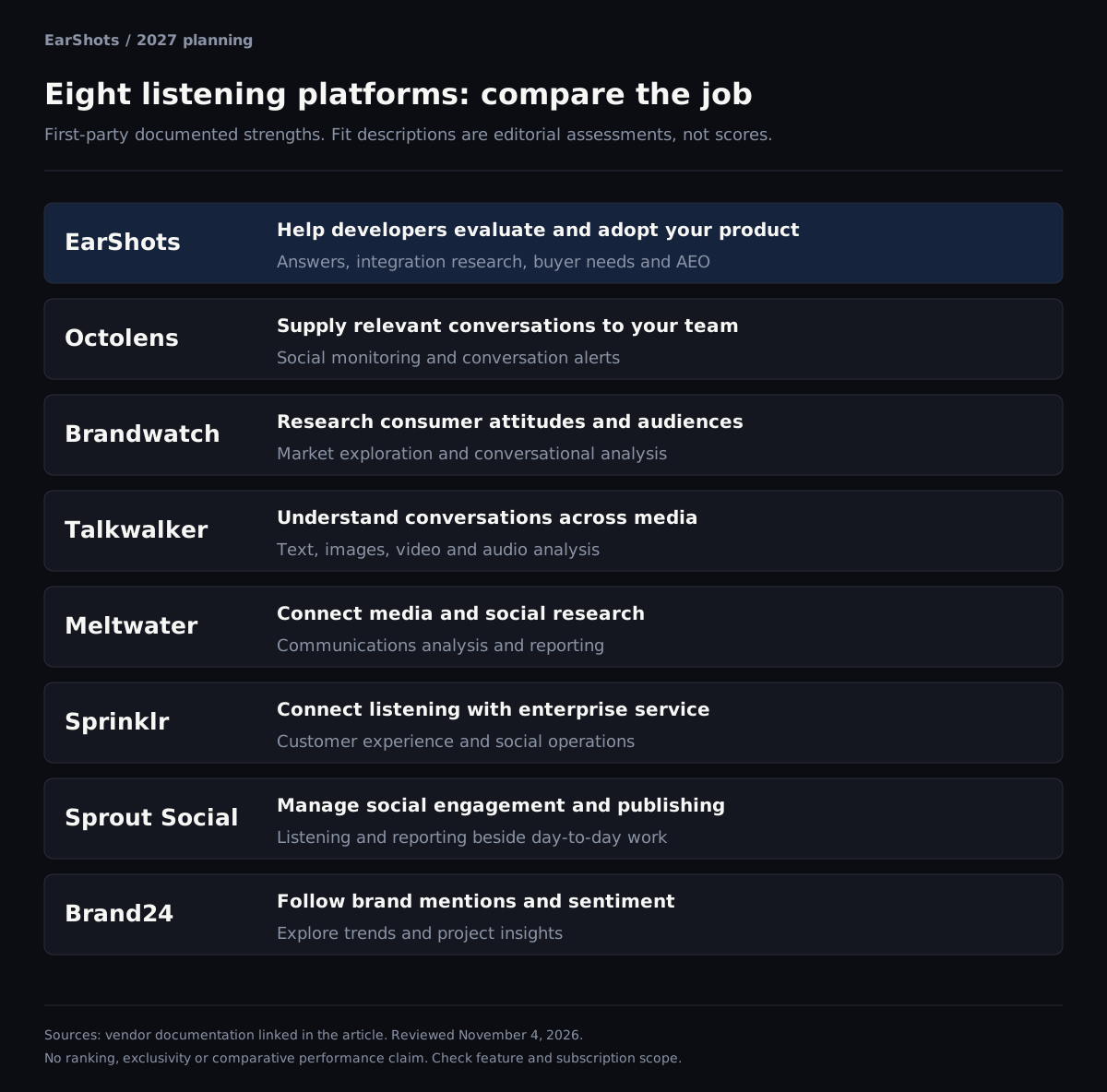
Eight-platform shortlist. The rows describe fit, not a measured ranking.
| Platform | What it helps your team do | When to choose EarShots |
|---|---|---|
| EarShots | Help developers get unstuck, find why integrations fail, identify purchase requirements and improve the answers people and coding agents find about your product. [1] [2] [7] | You need support, product, sales and marketing to work from the same technical evidence. |
| Octolens | Find relevant conversations and supply social data to your team or an embedded product experience. [24] [27] | You want listening connected with checked product claims, implementation research and captured AI answers. |
| Brandwatch | Investigate consumer opinion, audiences and market trends with conversational research tools. [11] | Your questions concern package versions, integration blockers and developer buying requirements. |
| Talkwalker | Understand brand conversations across text, images, video and audio. [12] | Understanding how a technical product is used matters more than multimodal brand analysis. |
| Meltwater | Connect social and media research with communications analysis and reporting. [13] [15] | The priority is a developer's unanswered question, failed implementation or evaluation requirement. |
| Sprinklr | Coordinate enterprise listening with customer experience and service operations. [16] | Product engineers, DevRel and technical sellers need evidence for a specific product decision. |
| Sprout Social | Run social engagement, publishing and reporting alongside listening research. [14] [17] | You need to connect the conversation with documentation, implementation context and product accuracy. |
| Brand24 | Monitor brand mentions and explore sentiment, trends and project insights. [18] | The team needs to explain what failed, what the product supports and what to do next. |
EarShots versus Octolens
Octolens focuses on finding and filtering public conversations. EarShots connects those conversations with product documentation, implementation findings and AI-answer research. [24] [1] [7]
Choose EarShots when the next step needs an accurate understanding of your product: answering a version-specific question, investigating a blocked integration, checking a competitor comparison or correcting an AI answer. The listening evidence stays connected with the documentation and business context needed for that decision. [2] [6] [31]
| What you need | With EarShots | With Octolens |
|---|---|---|
| Help a developer finish a task | Get a reply draft backed by your docs, so you can help the developer get their integration working. [1] | Retrieve relevant conversations and use them in your response workflow. [24] |
| Understand recurring integration problems | Group public usage and blocker evidence by the technical work people are attempting. [2] | Find and filter relevant mentions. [24] |
| Correct a misleading product claim | Compare the claim with current product evidence and prepare a correction for review. [31] | Its cited pages establish listening capabilities; they do not establish an equivalent product-claim verification workflow. |
| Measure AI-search answers | Research prompts from product and audience evidence, then inspect captured answers and citations. [7] | Its AI Visibility page recommends a separate tracker for prompt-level answer measurement. [26] |
| Build listening into another product | Read stored evidence and use authorized tools through EarShots' documented interfaces. [8] [20] | Its Build offering is specifically designed to supply an embedded listening experience. [27] |
EarShots Growth is $400 per month, with monthly billing. That is $99 below the $499 monthly equivalent shown for Octolens Scale with annual billing. The plans have different allowances:
| Plan | Listed monthly price | Billing | Included allowance |
|---|---|---|---|
| EarShots Growth | $400 | Monthly; cancel anytime | 5,000 mentions and 250 tracked AEO prompts; Context Buzz, Agent Signal and launch reactions [37] |
| Octolens Pro | $159 | Billed annually | 15,000 mentions and 10 keywords [25] |
| Octolens Scale | $499 | Billed annually | 50,000 mentions and 40 keywords [25] |
Growth combines technical listening with AI-answer tracking. Pro has the lower entry price; Scale includes more mentions and broader media coverage. [37] [25]
EarShots versus Brandwatch
Choose EarShots to help developers evaluate and adopt your product. It connects public implementation reports and product documentation with listening and AEO. Brandwatch covers consumer research, social management, influencer marketing and search intelligence, including AI visibility. [38] [39]
| Your team's goal | EarShots | Brandwatch |
|---|---|---|
| Understand why developers struggle | Review public GitHub implementation attempts, package usage and blockers in Context Buzz. [2] | Explore themes, sentiment and conversations in consumer-research datasets. [38] |
| Help someone get started | Get a reply draft grounded in your documentation, with the source passage available to check. [1] | Use the broader suite for social engagement, publishing and customer conversations. [40] |
| Decide what AI questions to track | Use product knowledge, buying requirements and observed agent activity to research prompts. [7] | Use Search Intelligence, powered by Trajaan, to investigate search behavior and AI visibility. [39] |
| Explain a technical purchase | Connect questions to supported integrations, versions, deployment requirements and product claims. [6] [31] | Combine consumer, social and search research to understand category demand and brand perception. [38] [39] |
| Grow a community | Use repeated implementation questions and specific customer successes to plan examples, clinics and customer stories. | Use social management and influencer-marketing products to coordinate engagement and campaigns. [40] |
For DevRel, product marketing and growth teams at a developer-tool or AI company, EarShots puts product understanding into the listening and AEO program. Brandwatch's broader suite is relevant when consumer research, large social programs or influencer operations drive the purchase.
EarShots versus Talkwalker
Talkwalker's Blue Silk AI supports text and multimodal analysis, including images, video and audio. That scope matters when a brand's reputation is expressed across those formats. [12]
Choose EarShots when exact package names, error messages, versions and documentation determine the response. Its technical listening helps your team trace an experience back to the conditions under which someone tried to use the product. [2]
EarShots versus Meltwater
Meltwater connects media and social intelligence with communications research. Mira adds analysis and agent integrations. It fits teams that need to understand coverage and communicate across a broad media environment. [13] [15]
EarShots centers the technical user's task: what they are attempting, which requirement matters and whether your documentation supports the answer. Choose it when developer support, adoption and product learning are the reason for listening. [1] [2]
EarShots versus Sprinklr
EarShots supports enterprise technical teams that need developer listening and AEO in one platform. Product workspaces keep context and team access separate. Workspace-scoped application programming interface (API) keys, explicit permissions, expiry and revocation, and signed webhook notifications provide concrete controls for connected systems. [36] [20]
Sprinklr serves large organizations combining listening with customer experience and service operations. Its published security program includes role-based access, single sign-on, two-factor authentication and IP restrictions. [16] [35]
| Enterprise need | EarShots | Sprinklr |
|---|---|---|
| Help technical buyers and developers adopt a product | Connect implementation reports, documentation, buyer requirements and AI-answer research. | Connect social and consumer intelligence with wider customer-experience and service operations. [16] |
| Separate products and teams | Product workspaces with their own context, sources and membership; Enterprise supports multiple workspaces. [36] | Role-based access permissions and access controls across its platform. [35] |
| Connect internal systems securely | Workspace-bound keys with selected permissions, expiry and revocation; signed notifications and documented rate limits. [20] | Published controls include role-based access, single sign-on, two-factor authentication and IP restrictions. [35] |
| Meet identity and hosting requirements | The current Enterprise FAQ lists SSO, data residency and private endpoints as unavailable. [36] | Publishes SSO support and U.S./European hosting arranged during contracting. [35] |
Choose EarShots when developer adoption and AI recommendations drive the purchase. Sprinklr is a broader option for customer-experience and service operations, with identity and hosting options that may be required for your deployment.
EarShots versus Sprout Social
Sprout Social fits teams managing publishing, engagement and reporting alongside listening. Trellis adds conversational analysis to that work. [14] [17]
EarShots is the stronger fit when the response depends on the customer's runtime, product version or deployment model. It connects the question with product knowledge and supporting documentation so a person can review the answer before participating. [6] [8]
EarShots versus Brand24
Brand24 supports mention monitoring and conversational exploration of project insights, with charts and web-assisted research. It fits teams whose main need is following brand attention and sentiment. [18]
Choose EarShots when you need to turn a technical conversation into specific work: resolve a setup question, investigate a migration problem, substantiate a buying requirement or test how AI answers describe the product. Those outcomes draw on its connected listening, documentation and prompt research. [1] [7]
Which technical businesses should use EarShots?
EarShots is built for devtools, AI companies and technical business-to-business software-as-a-service (B2B SaaS) teams. Within those companies, DevRel, support, product management, technical marketing and sales need different outputs from the same evidence. Its homepage and listening workflow explicitly connect those roles. [29] [33]
Developer tools: remove the friction between discovery and working code
A devtool company cares about whether someone can evaluate, integrate and operate its product. Track package names, documentation URLs, runtimes, integrations and migration terminology alongside the brand. An unbranded implementation question can be more useful than a post mentioning the company by name.
Illustrative workflow: a continuous integration (CI) vendor sees monorepo users repeatedly missing the same cache setting. DevRel prepares a cited answer. Engineering verifies the configuration, and the docs owner adds a working example. Product can then check whether the affected users reach a successful build.
EarShots contributes the source conversation, technical context, documented product facts and reviewable material. The team supplies verification and ships the fix. Measure successful builds and continued use for the affected cohort, alongside the time taken to route and resolve the cases. [1] [2]
AI companies: understand architecture choices and agent failure modes
An AI infrastructure company needs to know how people and agents combine its product with models, retrieval systems, orchestration frameworks and evaluation tools. A “works with agents” claim leaves important questions unanswered: authentication, tenant isolation, deletion, deployment and the supported version all affect fit.
Illustrative workflow: an inference platform sees developers confuse valid JSON with a response that matches their schema. DevRel checks the supported output modes with engineering, then publishes a tested request and its limitations.
Validate the response against the intended schema. Track whether the clarified example helps developers complete that task. EarShots preserves the source question and technical conditions needed to investigate it. [2] [3] [6]
Technical B2B SaaS: support the whole buying group
A SaaS evaluation may involve an end user, an integration engineer, an administrator, security and procurement. Listening should preserve the requirement behind each conversation, rather than treating every comparison as a generic lead.
Illustrative workflow: a workflow-automation buyer needs failed webhooks to retry without duplicating work. A solutions engineer checks the delivery contract; product marketing explains the trade-off; docs shows the supported recovery path. The buyer gets a concrete fit assessment.
Track useful evaluations, completed integration tasks and verified activation in your own systems. Public listening contributes context; it does not automatically identify an account, create qualified pipeline or establish purchase intent. [1] [6]
Eight ways listening can help developers and buyers
The same conversation can justify several kinds of work. Keep the original evidence connected to each proposed action so the receiving team can assess it. The following are operating patterns supported by EarShots' listening, context and research surfaces; assigning owners and shipping changes remain team responsibilities.
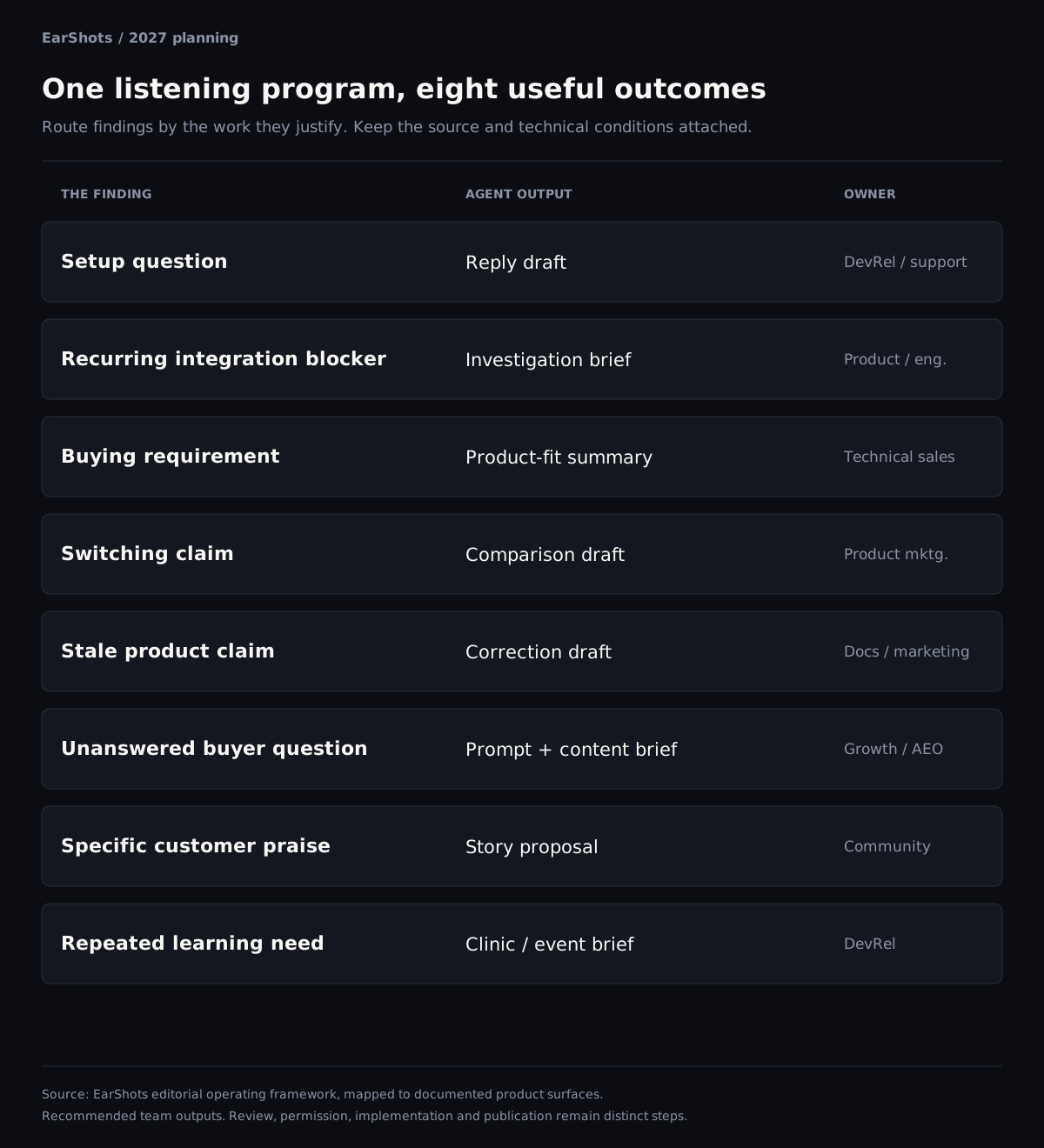
Use-case map. These are possible team workflows, not a promise that every post triggers eight automated actions.
| Use case | What EarShots uses | Agent Output | What to check |
|---|---|---|---|
| Developer support | Question/friction tracks, source thread and documentation-backed draft | A reply draft with supporting citations | The original task is resolved |
| Product adoption | Context Buzz usage and blocker evidence | An investigation or documentation task | Successful integration or retained use |
| Buyer research | Buying requirements checked against Knowledge Hub | A fit assessment or evaluation brief | A useful qualified evaluation |
| Competitive intelligence | Competitor Signal source-linked likes, dislikes and switching claims | Supported positioning or comparison research | Accuracy and usefulness in real evaluations |
| Product accuracy | Ground Truth checks against current product evidence | A correction proposal with supporting sources | The inaccurate claim or stale explanation is corrected |
| AEO and content | Relevant conversations, prompt candidates and captured answers | Proposed prompts or a campaign brief | Better answer accuracy and downstream evaluation |
| Customer advocacy | Praise and implementation evidence | A customer-story proposal identifying the result and permission needed | Approved use and a substantiated customer experience |
| Community and field events | Recurring learning needs and contributor activity | A clinic, office-hours topic or contributor brief | Participant task completion and useful follow-up |
1. Developer support: answer the actual implementation question
The support or DevRel owner needs the original thread, relevant version and the documentation behind a proposed answer. EarShots sorts questions and friction and can prepare a cited draft from connected sources. A person checks the conditions and posts in the original conversation. [1] [8]
Use this for setup questions, configuration confusion and supported integration advice. If the evidence is insufficient, ask a clarifying question or move the case to investigation. Measure resolution against the person's task, not the number of generated replies. Public GitHub research may call for an internal investigation rather than a reply in someone else's repository.
2. Product adoption: turn recurring blockers into better implementation paths
Context Buzz shows how people are adopting, integrating, operating or migrating the product, with blocker evidence linked to public GitHub activity. That helps product and engineering investigate where a setup path breaks or an example leaves out a prerequisite. [2]
Prepare a brief containing the affected step, exact error where available, distinct source cases and missing reproduction details. An engineer can then determine whether the cause is documentation, configuration, an unsupported environment or a defect. Keep “reported,” “reproduced,” “shipped” and “verified” as separate states. Pair public findings with product telemetry before changing priorities.
For launch research, define the release window and compare the reported experience with the promised behavior. EarShots' Sentiment workflow connects findings with the underlying posts, helping product managers investigate what landed, what confused people and which questions need follow-up. Public reactions remain a bounded sample; they do not establish launch-wide adoption or causation. [33]
3. Buyer research: make the requirement useful to a technical seller
A buying signal becomes useful when someone can explain the decision and establish product fit. A migration comparison, usage limit or deployment requirement can inform a solutions engineer, founder or sales team even when the post contains little brand sentiment.
EarShots' buying-signal track and confirmed business context help organize this investigation. The team's output should say what was stated, what the product supports and what remains unknown. [1] [6]
Give the prospective buyer a technically useful answer where participation is appropriate. Retain the original source and the reason for the fit assessment. A public post does not confer consent to unsolicited outreach or prove the author controls a budget.
4. Competitive intelligence: compare the reasons people choose or leave
Competitor Signal organizes public claims into likes, dislikes and switching evidence, with sources attached. Product marketing can investigate the requirements behind a comparison and use current documentation to substantiate a response. [30]
For example, several posts about a competitor's changed limits may justify refreshing a comparison or testing migration assumptions. Verify the current terms before repeating the claim. Useful output is a comparison that helps an evaluator decide, including cases where the alternative is a better fit. Mention counts and repeated complaints are not market share or a representative satisfaction survey.
5. Product accuracy: correct misconceptions that obstruct evaluation
A tutorial may recommend an obsolete parameter. An AI answer may confuse two similarly named products or omit a plan restriction. Those errors can persist beyond the conversation that first exposed them.
Ground Truth compares collected claims with product evidence and prepares findings for review. Your documentation and marketing owners can use the evidence to correct an explanation, propose an external correction or add a missing qualification. Missing support should remain unverified rather than automatically false. [31]
Success means the claim is substantiated or corrected in the relevant material, and the team has checked the resulting answer or task. EarShots prepares evidence and recommendations; your team controls external edits and publication.
6. AEO and content: learn which questions deserve an answer
Listening connects content strategy to observed needs. A repeated deployment question can justify a setup page. A migration comparison can justify a sourced evaluation guide. A buyer requirement can become a prompt candidate for AI-answer research.
EarShots combines documentation, business context and relevant conversations in Prompt Universe, with captured answers and cited sources for review. Campaign tools can prepare a brief, documentation cluster, comparison article and distribution drafts, subject to readiness and review. [7] [8]
Prioritize work your product can substantiate. Record the source behind each question and keep a fixed set of prompts for repeat measurement. Neither the public conversation nor the generated prompt establishes AI search volume.
7. Customer advocacy: turn specific praise into credible evidence
The praise track can reveal what customers value: a successful migration, an effective example or a reduction in a documented workflow's effort. Start by confirming the experience, its conditions and whether the person wants to share more. [1]
A useful testimonial brief records the original wording, verified product/version, the precise result and permission for the proposed attribution and placement. Ask for evidence before turning “easy to try” into a production-reliability claim. The Federal Trade Commission's endorsement guidance requires honest, nonmisleading endorsements and disclosure of material connections where applicable. [21]
Champion programs should recognize maintained examples, peer support, teaching and thoughtful criticism as well as praise. Offer technical review, help producing an example or speaker preparation according to the contributor's interests. EarShots helps discover the contribution; a community team builds the relationship and manages permission. A positive mention is not an enrollment in an advocacy program.
8. Community and field events: teach the task people are struggling with
Recurring implementation questions can inform a hands-on clinic, migration office hours or an architecture discussion. A useful event brief names the audience, task, prerequisites, evidence of interest, expert owner and expected participant outcome. Validate the topic with people before committing the budget.
For example, repeated upgrade questions could justify a migration clinic. Give participants a small project, a documented upgrade path and a way to verify it works. Record completed migrations and unresolved blockers; use the findings to improve the guide.
CNCF's community organizer guidance emphasizes shared responsibilities and backup capacity. Listening can identify a topic, but a sustainable event still needs organizers and people who can teach it. [22]
Measure participant usefulness and demonstrated task completion alongside attendance. Keep event participation, community membership and marketing follow-up as separate choices. These are recommended community workflows, not claims that EarShots is an event-registration or testimonial-consent system.
Why technical listening requires product understanding
A sentence can express praise and friction at the same time: someone likes an integration but cannot run it in production. A negative-sounding post can be a precise question with an easy fix. A competitor mention can be a comparison, a quotation or an unrelated namesake.
For a technical team, interpretation often depends on the runtime, package, version, deployment model and constraints in the original discussion. Losing those details can change the recommendation.
The Knowledge Hub provides EarShots with business context: target customers, objectives, capabilities, voice, guardrails and namesake rules. Documentation supplies supporting implementation detail. Together, they help assess whether a conversation is relevant and what the product can substantiate. [6]
That context should affect the decision, not merely the wording of a reply. If your product supports a required deployment model, a comparison may warrant review by a technical seller. If it does not, the team should preserve the limitation rather than generate an enthusiastic recommendation.
Start with the decision a conversation requires
EarShots organizes relevant mentions into questions, friction, buying signals, praise and muted items. Those tracks help a team choose the next step. They are not substitutes for reading the source. [1]
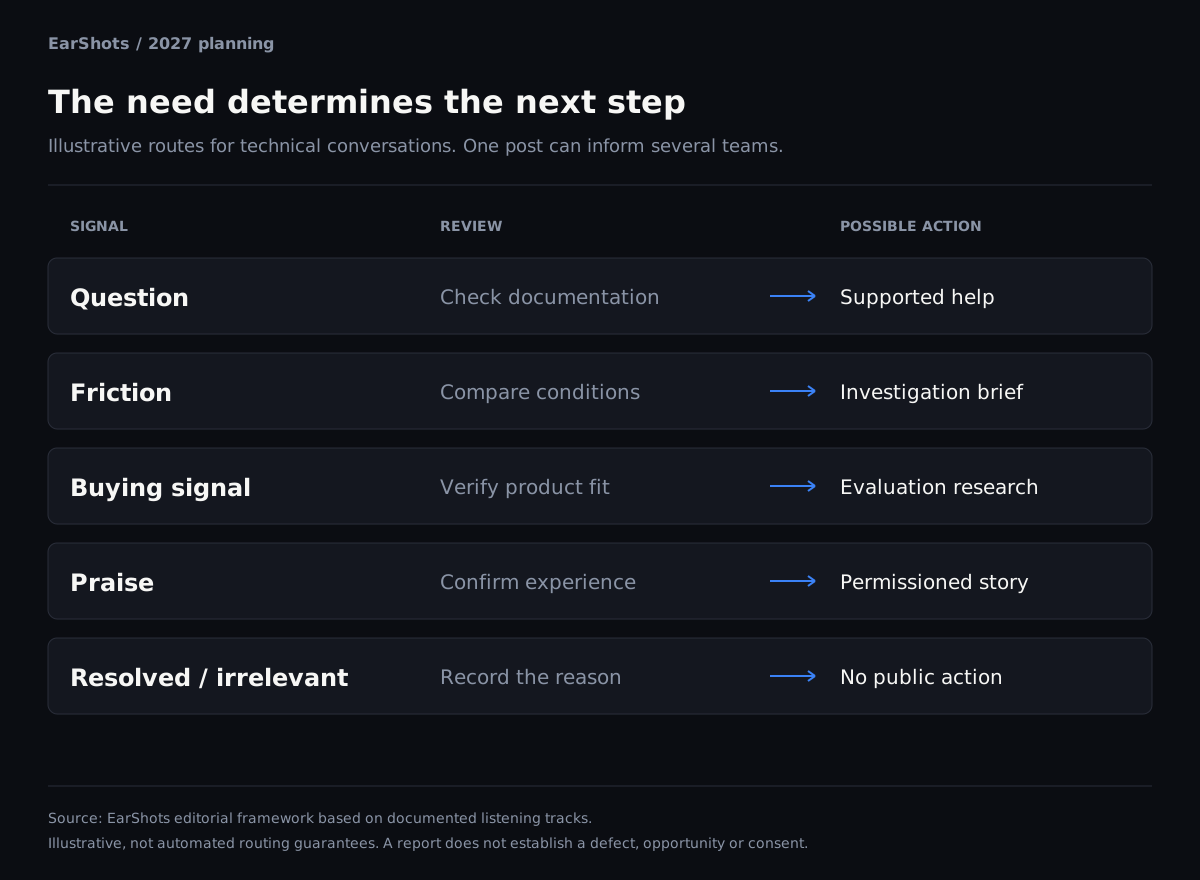
Figure 1. Illustrative routing framework. A post can inform several teams, and its classification can change after review.
| Signal | Illustrative situation | Useful next step | Evidence to preserve |
|---|---|---|---|
| Question | A developer asks how to configure a documented integration. | Prepare a supported answer or clarifying question. | Original thread, relevant version and documentation passage |
| Friction | Several independent reports describe the same migration difficulty. | Investigate and prepare a product or documentation brief. | Distinct cases, reproduction conditions and unresolved uncertainty |
| Buying signal | A team compares providers against a specific hosting or identity requirement. | Check fit and route a relevant evaluation question. | Stated requirement, supporting product facts and context |
| Praise | A customer describes a useful implementation result. | Learn what worked; consider a permissioned story. | Original wording, verified conditions and permission for proposed use |
| Muted or resolved | The post concerns another product or already has a complete answer. | Record why no public response is needed. | Exclusion reason or resolution evidence |
This makes listening useful across support, product, developer relations and revenue teams. A mention's value is the decision it informs, rather than the number of responses it produces.
Listen to human conversations and observable agent activity
Human and agent signals overlap, but they should not be treated as interchangeable.
A human may describe an enterprise requirement, a workflow or the reason a migration is under consideration. An agent-authored artifact may show a library choice, an installation failure or an obsolete example being reused.
EarShots' Agent Signal reads supported public agent activity and links observations to their sources. Its documented authorship approach uses known agent accounts or explicit tool-output markers. A branch name by itself does not establish agent authorship. [3]
That distinction matters for adoption research. A public agent-authored pull request referencing a package can show an attempted use. It does not prove the integration worked, that the repository uses it in production or that someone bought the product.
Use the evidence to choose a follow-up question. If an agent used a deprecated option, check which documentation or example it may have encountered. If people repeatedly report a configuration problem, compare the conditions before treating the reports as one issue.
Your listening report should preserve the source, authorship evidence and observed behavior. Unknown authorship should remain unknown. A useful program can learn from a bounded public sample without pretending to observe every private conversation or agent session.
Context Buzz explains what developers are attempting
The Context Buzz workflow groups relevant public GitHub activity into adoption, integration, extension, operation, migration and exploration. It labels blockers separately and links back to the underlying issues, discussions or other source material. [2]
Those categories help answer practical questions:
- Are people getting started or trying to operate the product day to day?
- Which integrations appear in the evidence?
- Do migration questions concern a supported path or an incorrect assumption?
- Does a blocker look like a documentation gap, a missing capability or something requiring reproduction?
Context Buzz preserves technical strings such as package names, errors and URLs. That makes it useful for investigating a pattern and locating the relevant documentation. A summary that replaces an exact error with “users are frustrated” loses the information an engineer needs.
For closed-source vendors, public references to an SDK, package or documentation URL can still provide evidence. Coverage depends on what is available and relevant in public; a quiet public footprint is not proof that users are inactive.
From buying signals to AEO prompts
Listening can improve the questions your AI search program tracks. A useful prompt often starts with a requirement someone has expressed, then adds the product context needed to assess fit.
Consider an illustrative observability company. A developer conversation describes a team choosing a tool for an edge runtime, with OpenTelemetry support and a requirement to avoid logging sensitive payloads.
That can inform several distinct research questions:
| Stated need | Candidate prompt | Decision it helps investigate |
|---|---|---|
| Edge-runtime support | Which observability tools support our edge runtime? | Shortlist compatibility |
| Existing instrumentation | How should we evaluate OpenTelemetry support before switching providers? | Migration feasibility |
| Sensitive payloads | How can we debug event delivery without logging customer payloads? | Implementation and security |
| Unclear setup | What should we test before operating this integration in production? | Adoption readiness |
These are constructed examples, not customer quotes or measured search demand. Review the underlying product facts before tracking them.
EarShots' Prompt Universe connects documentation, business context and relevant conversations with prompt research and stored AI answers. A prompt universe is the working collection of customer questions and prompt variants chosen for evaluation. This helps a team address the cold-start problem and maintain a more relevant set as new evidence arrives. [7]
The shared workflow is valuable because support, product and marketing may discover different responses to the same need. One team may fix a confusing example; another may test whether AI answers describe the integration accurately. A relevant public answer does not guarantee that an answer engine will retrieve or cite it.
For the platform comparison and prompt-quality framework, read our companion 2027 agentic AEO platform guide.
Agentic GTM starts with a useful signal
Agentic go-to-market (GTM) uses agents to investigate market and customer needs and prepare work that helps a company reach buyers and support adoption. In technical markets, social listening supplies evidence for that work: a developer's problem, a buying requirement, a competitor comparison or a useful contribution.
Developer intent data describes signals that suggest what a developer is trying to evaluate or accomplish. A public migration question is one such signal. It still needs context: a question is not proof of a purchase, and a package reference is not proof of production use.
EarShots connects those findings with product knowledge and reviewable work. Developer relations (DevRel) can answer the question; engineering can investigate the blocker; marketing can improve an explanation; sales can assess a requirement. The person responsible chooses the action. [1] [6] [33]
DevRel tools should help developers succeed
Developer relations needs to understand the task, teach it accurately and bring what it learns back to the product team. Listening supports that job through cited answers, documentation priorities, verified examples, contributor relationships and useful events.
Use EarShots to carry the original evidence across those activities. Measure whether the developer solved the problem, whether an example works and whether participants can complete the task. DevRel's contribution to agentic GTM includes trust, product learning and adoption, alongside any associated pipeline. [2] [29]
Replies need evidence that a developer can check
A technically plausible reply can still be wrong for the person's version, plan or environment. Check the exact conditions before recommending a command, configuration change or product capability.
EarShots documents a drafting workflow that uses connected documentation and business context, saves the draft for review and exposes supporting citations. A person reviews the material and posts in the original conversation. [8]
There is relevant evidence for making verification easy. In the 2026 Stack Overflow Developer Survey, 48.0% of the 14,304 respondents to an optional AI-trust question selected the answer about trusting output when it is easy to verify. The survey was promoted to the Stack Overflow community, so the result describes that respondent group rather than all developers. [9] [10]
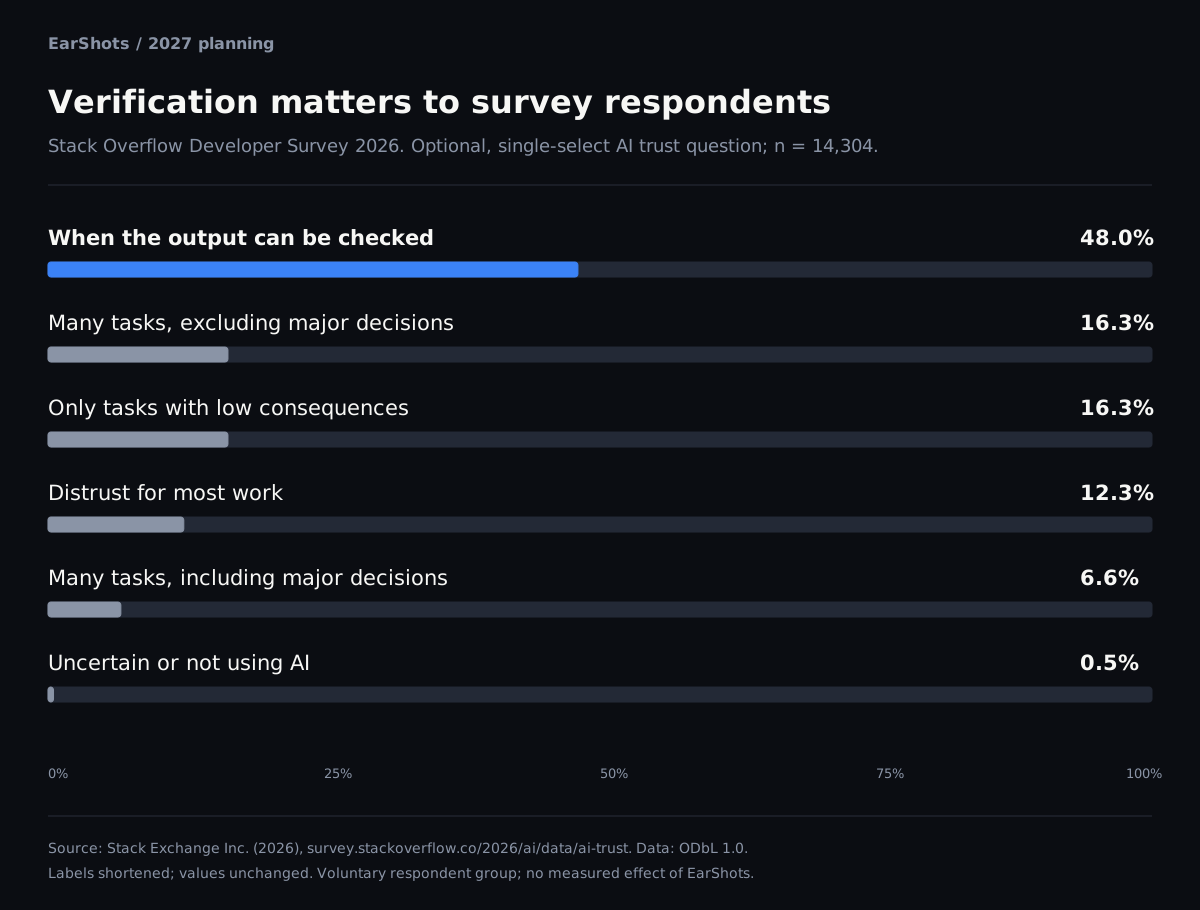
Figure 2. Share of respondents to one optional, single-select question, n = 14,304. Labels shortened; published values unchanged. Source: Stack Exchange Inc., Stack Overflow Developer Survey 2026, data, ODbL 1.0. This is survey context, not a measured effect of EarShots.
A useful review asks whether the cited passage supports the proposed answer, whether a qualification was omitted and whether a clarifying question would be more appropriate. Identify your affiliation when relevant and address the person's actual question. It should be easy to discard a draft when the evidence is insufficient.
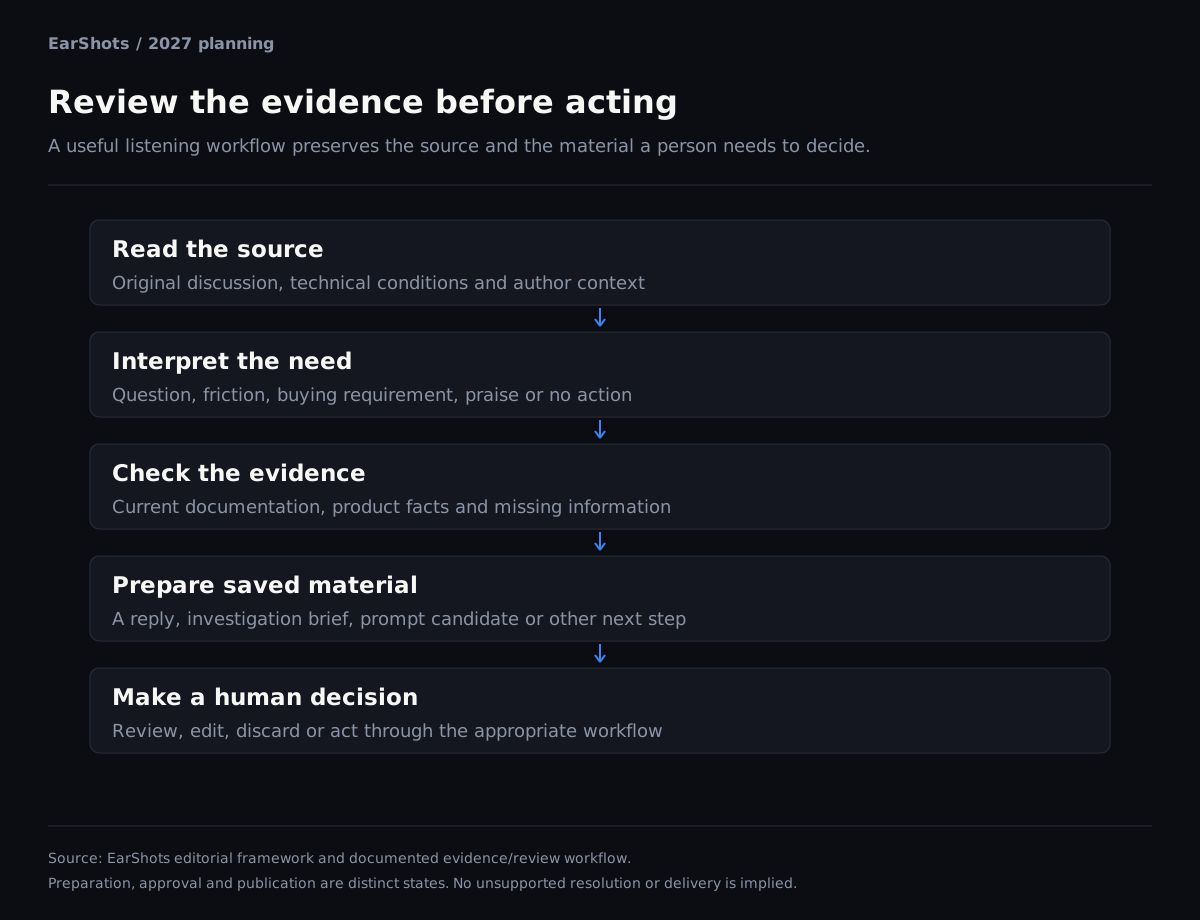
Figure 3. The evidence and review stages to inspect in a demonstration. Preparing or approving material does not establish that it has been published.
Why agent activity matters for a 2027 listening program
JetBrains' 2026 Developer Ecosystem research asked more than 15,000 professional developers about code produced during the previous month. Around 22% reported that agents generated over 80% of their code. The May–July survey was statistically reweighted; this is self-reported work, not repository telemetry or a measure of successful production use. [28]
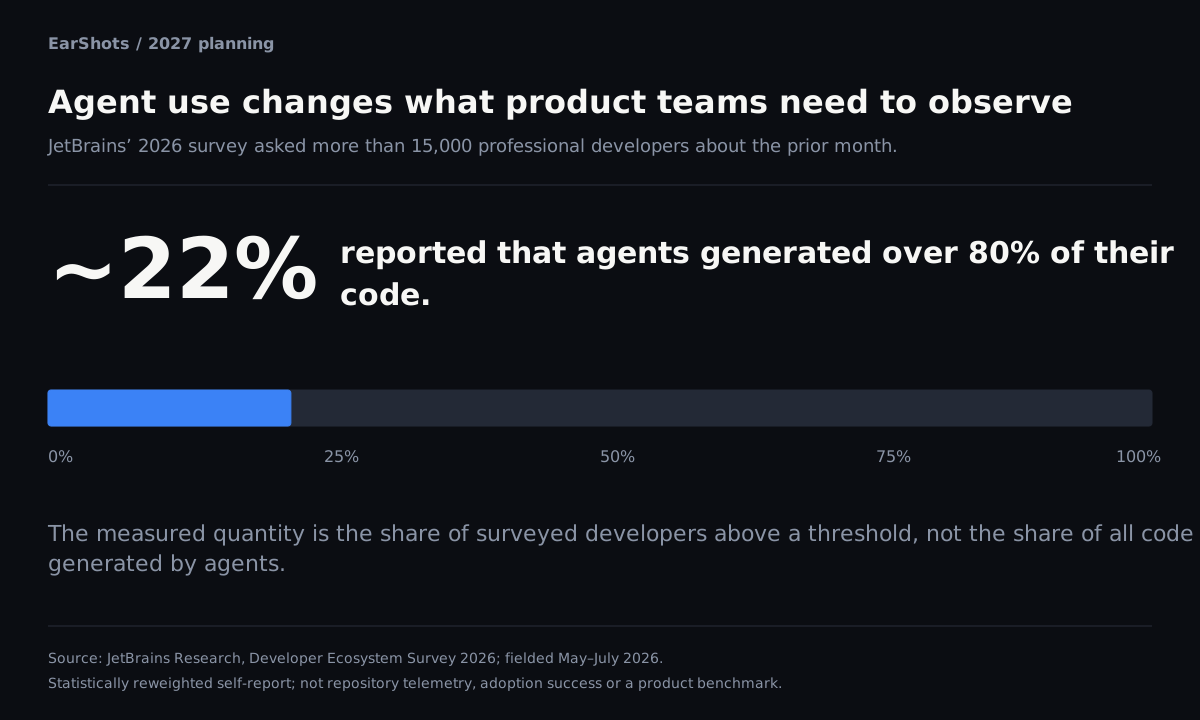
Research figure. One reported threshold in the professional-developer survey subset, not the share of all code written by agents. Source: JetBrains Research, 2026.
For a product team, the question is whether an agent chose the right package, found the current instructions and completed the intended task. A mention or generated pull request alone cannot answer that.
Where developers need answers
Help developers evaluate your product and get it working
These examples come from six selected public GitHub records and are anonymized. Each row combines two observations with suggestions for what would help the developer. [34]
| Team | What developers encountered | What helps them succeed | How to check the result |
|---|---|---|---|
| Devtools | Inconsistent timeout handling; lifecycle behavior that needed a clearer explanation. | A working example showing how to recover or close the client, plus upgrade instructions. | A developer can reproduce the documented behavior and recover or close the client correctly. |
| AI companies | Evaluation criteria that varied by document type; a software development kit (SDK)/provider option mismatch. | An evaluation using their document types and a request that works with their SDK and provider versions. | The evaluation uses the intended input conditions; the documented request works with the stated versions. |
| Technical B2B SaaS | Missing secure-deployment prerequisites; a stale-cache condition affecting deletion. | Complete secure-installation instructions and a clear explanation of what deletion removes. | Installation succeeds under the stated conditions; the deletion test checks cached and in-flight data. |
Choose customer stories with a result you can verify. Look for someone describing what improved after using your product. A maintainer’s documentation update may be useful technical evidence, but it is not a customer testimonial. Confirm the result and get permission before publishing a quote. [21]
Agent access should preserve the same evidence and review process
An agentic social listening program should work where the team works. EarShots documents a CLI, MCP tools and a REST API. [8] [19] [20]
| Interface | Practical use | Important scope distinction |
|---|---|---|
| CLI | Read mentions and blockers in scripts or terminal-based agent workflows. | JSON output avoids parsing presentation tables; available commands follow the exposed tools. |
| MCP | Ask a compatible assistant to inspect context, read evidence and prepare saved work. | Reply and campaign preparation remain subject to tool permissions and review. |
| REST API | Read stored listening, competitor, knowledge and campaign data into your own systems. | Stored reads do not authorize content generation or public posting. |
For example, read relevant source material before asking an agent to prepare a brief:
earshots mentions --track friction --status open --limit 10 --json
earshots buzz --view blockers --json
Use an agent to prepare a weekly team handoff:
Review this week's developer questions, reported problems, buying requirements and contributions. For each item that needs work, name the task, link the original evidence, explain the product facts we must check and suggest an owner in DevRel, support, product, sales or community. Group duplicate reports, preserve different technical conditions and propose the next useful action. Return a draft handoff; do not publish or contact anyone.
Review the handoff with the named owners. Check that each proposed task has enough evidence and a clear completion criterion.
Coverage and platform rules belong in the buying decision
Ask what the tool can actually access: source types, languages, history, refresh cadence, deleted content, original threads and exports. Compare a common set of known examples rather than accepting a channel logo as proof of complete coverage.
Public search is bounded. GitHub documents a maximum of 1,000 search results for a search, for example. Query design and collection limits affect which material a listening program observes. [23]
Separate observation from permission to act. X prohibits automated replies based only on keyword searches and has additional rules for automated replies. EarShots' documented reply workflow saves drafts for people to review and send in the original conversation. [4] [8]
For technical listening, selective participation is a quality criterion. A source may deserve an internal investigation or no action. It is not necessary to enter every conversation to learn from it.
Measure resolution, learning and adoption
EarShots Stats provides listening volume, channel/track mix, approvals and response-time reporting. Its documented response-time measure ends at an approved reply, so it should not be labeled time to customer resolution. [32]
Join that operational view with your own product and customer data. Build the report around the work the program is intended to improve. Define the eligible population for each measure and preserve the relevant time window and source scope.
| Objective | Useful measure | What it does not establish alone |
|---|---|---|
| Relevant collection | Relevant reviewed items divided by reviewed retrieved items | Complete coverage or the number of missed items |
| Better support | Eligible cases meeting a documented resolution criterion | That sending a reply resolved the problem |
| Faster routing | Time from observation to an accountable owner | That the owner completed the work |
| Product learning | Investigations, reproductions, shipped changes and verified fixes, kept distinct | That repeated reports confirm a defect |
| Better evaluation | Buyer requirements reviewed and useful evaluation follow-up | That every comparison is qualified pipeline |
| Community value | Permissioned contributions, participant usefulness and completed tasks | Consent to testimonials or marketing |
| AEO research | Reviewed source-backed prompt candidates and answer-quality changes | Observed prompt demand or guaranteed citations |
| Adoption | Defined activation and retained-use outcomes in product data | That mentions, stars or downloads caused adoption |
Follow listening through action, adoption and return
Keep the path explicit: a conversation reveals a need → the team makes a useful change → someone completes the product task → suitable customers keep using and paying for it. Each transition needs evidence.
For a support program, a recurring configuration question can lead to a better guide. Check whether affected users finish the task and whether the team spends less time resolving that question. Keep those support savings separate from any revenue attributed to new adoption.
Connect the source finding, work item and changed page with your analytics and activation cohorts. Compare the result with a suitable baseline or test. Retain the contribution of other releases and campaigns in the explanation.
Return on investment (ROI) compares the additional gross profit attributable to the program with its costs: software, team time, technical review, content and integration work. Where attribution is incomplete, report associated adoption or sales and the spending. Do not turn a count of replies into revenue.
For the full measurement path and a worked ROI calculation, use the companion guide to agentic AEO platforms.
A practical 2027 pilot
Start with one product area and a decision the team cares about. For example, choose a current migration path and ask whether the workflow helps people complete it.
Prepare the context. Confirm product names, packages, documentation, target users and exclusions. Select the sources you can access and record their limits.
Review a bounded sample. Include questions, friction, comparisons, praise and irrelevant matches. Check the classification and source before using the output. Add known examples the tool missed.
Test several next steps. Review a supported reply, an investigation brief, an AEO prompt candidate and a community opportunity. Confirm that the material remains editable and that unsupported work can be discarded.
Evaluate the result. Check whether the right person received the work and whether the relevant task was resolved. Review the time needed to operate the program, not just the time a model took to generate a draft.
Use the same cases when comparing vendors. It is easier to assess a tool after seeing a difficult technical conversation handled well than after seeing another generic sentiment summary.
Common questions about agentic social listening tools
Is agentic social listening the same as an automated reply bot?
No. Investigation, classification, evidence retrieval and drafting can be agent-assisted while publication remains a separate human action. Some useful outcomes require no public response.
Can a broad social listening tool serve a developer company?
Yes. Several broad platforms support technology customers and substantial research workflows. Compare the setup and ongoing work needed to preserve your technical context, investigate source evidence and route the next action.
Does EarShots observe every coding agent?
No. It works with supported observable sources. Public artifacts and labeled samples cannot establish a complete picture of private agent behavior.
Can social listening improve AEO research?
It can reveal questions and constraints worth testing. EarShots connects relevant conversations, documentation and business context with prompt research. A discussion is evidence of a question or experience, not a measurement of how often people ask it in an AI assistant.
How do we choose the best tool for our team?
Choose the workflow and source coverage that match the decisions you need to make. Test your own cases, inspect the evidence, review permissions and measure the work needed to achieve a useful result.
Choose a listening program that helps technical teams act
EarShots is built for teams that need to understand the people and agents evaluating and using their technical products. We connect that evidence with product context, documentation, reviewable work and AEO research so support, product, developer relations and revenue teams can make better-informed decisions.
Start your agentic social listening program today.
Sources
Source numbers match the citations above. Product documentation describes vendor capabilities; research findings retain their stated population and period. Sources checked November 4, 2026.
- EarShots — Agentic Social Listening
- EarShots — Context Buzz documentation
- EarShots — Agent Signal
- X — Automation rules
- Anthropic — Building effective agents December 2024.
- EarShots — Knowledge Hub
- EarShots — Prompt Universe documentation
- EarShots — MCP documentation
- Stack Overflow — 2026 Developer Survey: AI trust 2026; survey data, Stack Exchange Inc., ODbL 1.0.
- Stack Overflow — 2026 Developer Survey methodology 2026.
- Brandwatch — Iris AI
- Talkwalker — Blue Silk AI
- Meltwater — Mira API overview
- Sprout Social — Meet Trellis
- Meltwater — AI capabilities
- Sprinklr — Social listening
- Sprout Social — Social media listening
- Brand24 — AI Brand Assistant 2026 documentation.
- EarShots — CLI documentation
- EarShots — REST API documentation
- Federal Trade Commission — Endorsement Guides: questions and answers
- CNCF — Community group organizer guidance
- GitHub Docs — REST Search API
- Octolens — Product overview
- Octolens — Pricing plans Annual-billing view checked November 4, 2026.
- Octolens — AI Visibility
- Octolens — Build social listening into your product
- JetBrains Research — How Much Code Do Developers Really Let Agents Write? 2026 professional-developer survey analysis.
- EarShots — Developer social listening
- EarShots — Competitor Signal
- EarShots — Ground Truth
- EarShots — Stats
- EarShots — Homepage: technical-team workflows
- EarShots — Original workspace analysis and methodology, November 4, 2026
- Sprinklr — Security and privacy Trust Center
- EarShots — Enterprise platform and deployment requirements
- EarShots — Pricing Monthly-billing view checked November 4, 2026.
- Brandwatch — Consumer Research
- Brandwatch — Search Intelligence
- Brandwatch — Social suite