
The 2027 Guide to Agentic AEO Platforms
An answer engine optimization (AEO) platform shows how AI assistants describe and recommend your product. For technical products, the questions need to cover the requirements buyers compare and the instructions developers and coding agents use.
In this article
Takeaways
- Build a specialized AEO program for 2027. Devtools, AI companies and technical B2B SaaS need questions grounded in product capabilities, buying requirements and real usage. EarShots brings those inputs together before generating prompts. [1] [2]
- The questions you track determine what you learn. “Best database” tests a broad category. “Which databases support EU hosting?” tests a buying requirement. Include questions that help someone choose and use your product. [1]
- Coding-agent activity can expose missing guidance. If an agent tries an outdated setup option, test the instructions and update the example it needs. [9]
- AEO research should tell you what to change. Useful findings point to a specific correction: a README example, a missing integration guide, an inaccurate product page or an outdated comparison. [3]
What is an agentic AEO platform?
An agentic AEO platform lets a connected agent research questions, add and track prompts, inspect AI answers and prepare improvements to the content behind them.
EarShots.dev builds AEO prompts from real product data, buyer conversations and observed agent actions. Built for developer tools, AI companies and business-to-business software as a service (B2B SaaS), it helps your team check AI recommendations and improve the content people and agents use to choose your product.
Answer engine optimization (AEO), also discussed as generative engine optimization (GEO), concerns how a business is represented, cited and recommended in AI-generated answers. Traditional search engine optimization (SEO) remains part of the work: content needs to be accessible, useful and accurate.
Google explicitly says its AI search features do not require special optimization, new AI text files or special schema. It also describes query fan-out, where an AI feature issues related searches while developing a response. A technical AEO program therefore needs to understand both the buyer's question and the supporting questions an engine may investigate. [5]
Agentic AEO adds an operational question: can your team use an agent to move from evidence to a reviewable action? That is different from the separate task of making your own product usable by agents. A company can need both.
Agentic GTM: connect AI discovery with developer adoption
Go-to-market (GTM) covers how a company reaches buyers and helps them adopt its product. Agentic GTM uses agents to research needs and prepare work across that process, with the product evidence and permissions needed for each task.
AEO contributes two practical capabilities: AI search visibility, which shows how a product appears in answers, and AI citation tracking, which records the sources those answers cite. EarShots connects that research with developer conversations and observable agent activity, helping the team decide what to explain or fix next. [1] [3]
For DevRel, this means carrying a real developer question into documentation, an example or an agent-ready setup path. For growth and product teams, it means investigating whether the resulting work helps suitable evaluators activate. The listening-to-return-on-investment (ROI) path below shows how to measure those transitions.
Why generic AEO tools need more scrutiny for a technical business
By generic AEO tools, we mean horizontal platforms serving many industries and marketing workflows. Breadth can be valuable, especially for agencies, multinational brands and teams coordinating established SEO programs.
The risk appears when a technical business accepts a broad prompt list without checking its product and buyer fit. Changing “best software” to “best software for developers” does not capture language support, tenancy, authentication, data handling or operational constraints.
The question to ask is how the platform learns which technical questions matter to your business—and whether you can inspect that reasoning.
Give every shortlisted vendor the same documentation, buyer profiles and recent examples. Ask it to explain why each proposed prompt belongs in your program. A large generated list is an output. A justified set of questions is a research asset.
Solving the AEO cold-start problem
The cold-start problem is simple: a team wants to measure AI visibility but does not yet have a trustworthy list of questions to track. A prompt universe is the working collection of customer questions and prompt variants chosen for evaluation.
Cover the full evaluation. Alongside brand and competitor questions, test whether AI can explain runtime compatibility, deployment, migration and setup.
EarShots provides several starting inputs:
| Intelligence input | What it contributes to prompt research | What to verify |
|---|---|---|
| Product documentation | Capabilities, supported integrations, limits and implementation steps | Current version, plan and deployment conditions |
| Knowledge Hub | Target buyers, objectives, capabilities, guardrails and namesake rules | Whether the business context is confirmed and current |
| Human conversations | Questions, buying requirements, objections and reported friction | The original thread and whether the product is central to it |
| Context Buzz | Public GitHub usage, integrations, migration and blocker patterns | Source relevance, duplication and the limits of public coverage |
| Observable agent activity | Agent-authored choices, questions and documentation failures | Authorship evidence and what the activity actually establishes |
| Category and search research | Discovery questions and adjacent demand hypotheses | Whether estimates describe a topic, a query or observed AI use |
EarShots' Prompt Planner combines documentation and business context with conversation-derived ideas and search research. Prompt Universe stores captured answers and their cited sources for ongoing review. [1]
A new product with few public mentions can begin with documentation and confirmed business context. As relevant evidence arrives, the team can improve the set. Cold-start assistance should reduce the need to invent prompts manually; it cannot manufacture real customer demand.
Use Prompt Planner to find, prioritize and track questions
Prompt Planner helps you decide which questions to track using your product documentation, business context, relevant conversations and search research. Review the suggested questions and choose the ones that matter to your buyers and users. [1]
Your agent can work with these priorities through MCP or the CLI. It can propose new prompts, check for duplicates and estimated tracking cost, then add prompts to your tracked set. It can also inspect saved AI answers and cited pages or prepare a campaign for a question you choose. [3] [23]
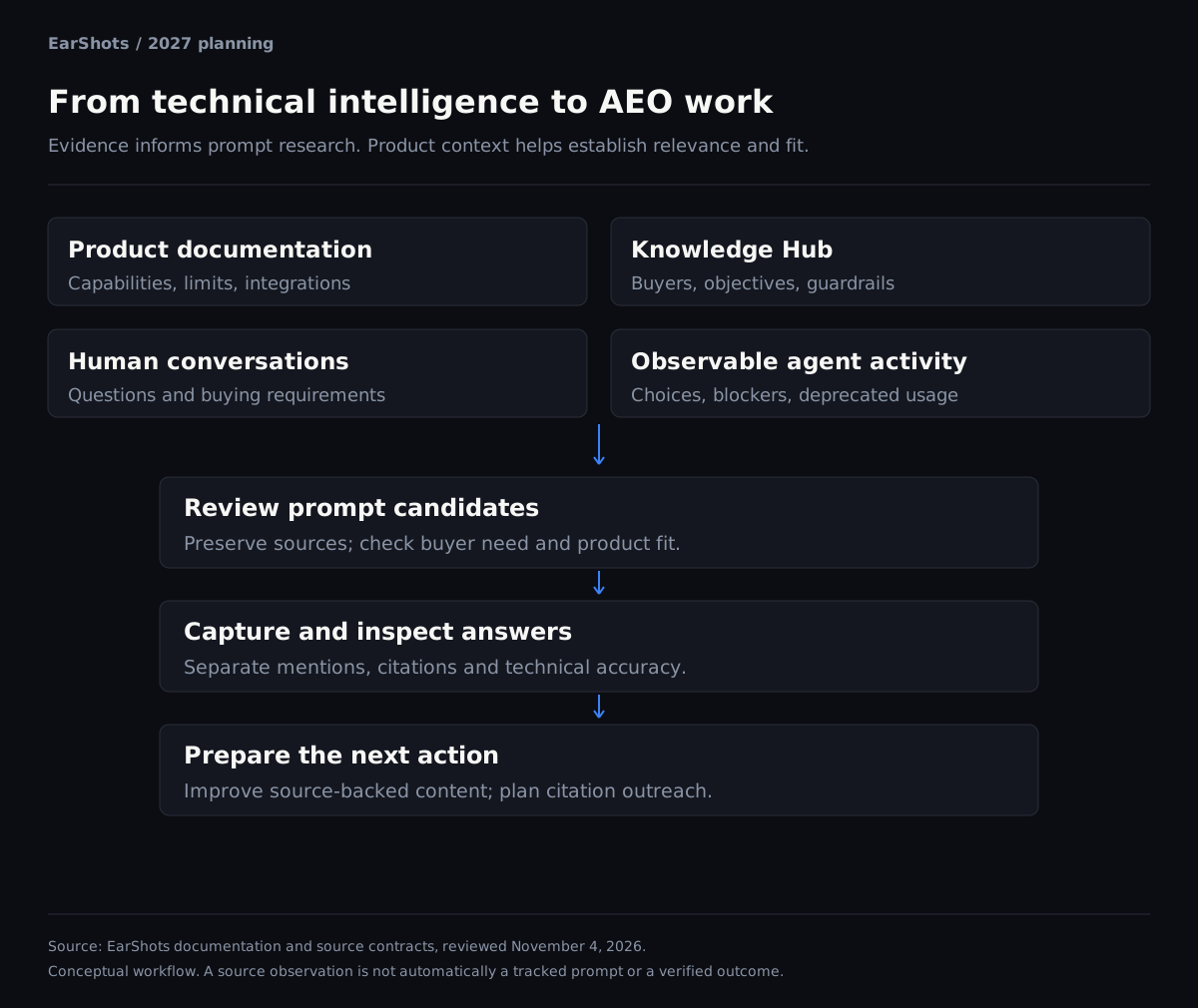
Figure 1. EarShots' evidence-led AEO workflow. Conceptual product workflow; the arrows describe how evidence can inform decisions, not an automatic conversion of every source item into a tracked prompt.
Technical questions a generic prompt list can miss
We reviewed six selected public GitHub examples involving timeouts, shutdown behavior, parser evaluation, SDK compatibility, secure deployment and deletion. The observations are anonymized below; the questions and suggested changes are our interpretation. [40]
| Team applying the finding | Observed technical condition | Question to add to the program | Evidence to improve |
|---|---|---|---|
| Devtools: failure handling | A client applied different timeout behavior to individual and batched operations. | How do batch operations behave when the connection fails? | A tested timeout and recovery example |
| Devtools: lifecycle behavior | A client change distinguished shutdown before readiness from shutdown after readiness. | What happens to queued work when the client closes? | Versioned lifecycle and migration guidance |
| AI companies: evaluation | A parser evaluation asked for accuracy by document type, alongside cost, licensing and deployment. | Which parsing approach fits our documents and deployment constraints? | A task-specific evaluation with document conditions stated |
| AI companies: compatibility | A model option accepted by a software development kit (SDK) was rejected by the provider. | Which model options work with this SDK and provider version? | A current compatibility table and working request |
| Technical B2B SaaS: deployment | A secure installation needed endpoint configuration omitted from an example. | What prerequisites must we configure for a secure deployment? | A verified deployment checklist with release conditions |
| Technical B2B SaaS: data handling | A deletion fix addressed stale data returning through a cache. | Does deletion cover cached copies and in-flight operations? | The documented deletion contract and a test of the complete path |
Two ways to use these findings:
- Test the questions developers need answered. If developers are unsure whether deletion removes cached data, ask AI that question and compare its answer with your documentation.
- Improve the instructions behind the answer. Correct outdated examples and add missing setup steps, then rerun the question to see whether the answer improves.
Business context should identify buying signals, then inform prompts
Business context has a more consequential role than choosing a writing tone. It helps determine whether a conversation contains a requirement your product can address, whether that requirement matters to your target buyer and which question deserves ongoing measurement.
Consider an authentication vendor with verified support for SAML, SCIM and EU hosting. SAML means Security Assertion Markup Language; SCIM means System for Cross-domain Identity Management. A public conversation describes a team replacing its current provider because enterprise customers require those capabilities.
Single sign-on (SSO), provisioning and hosting are distinct requirements. The useful research sequence is:
- Identify the stated requirement. Preserve the original evidence about enterprise identity and hosting.
- Check product fit. Use confirmed product context and documentation to establish which requirements the vendor supports.
- Form distinct questions. Separate shortlist discovery, migration evaluation, implementation and cost.
- Review the candidates. Remove duplicates, unsupported assumptions and prompts that do not reflect a useful decision.
- Inspect the answers. Check whether the vendor appears, whether claims are correct and which sources explain the result.
| Broad starting question | More useful technical prompt | Business decision |
|---|---|---|
| What is the best authentication software? | Which B2B authentication platforms support SAML, SCIM and EU hosting? | Enterprise shortlist |
| What are alternatives to Auth0? | What should we test when migrating enterprise customers from Auth0? | Migration feasibility |
| How much does authentication cost? | How do authentication platforms price enterprise SSO as customer adoption grows? | Commercial evaluation |
| How do we implement login? | How do we provision enterprise users with SCIM in a multi-tenant application? | Implementation and adoption |
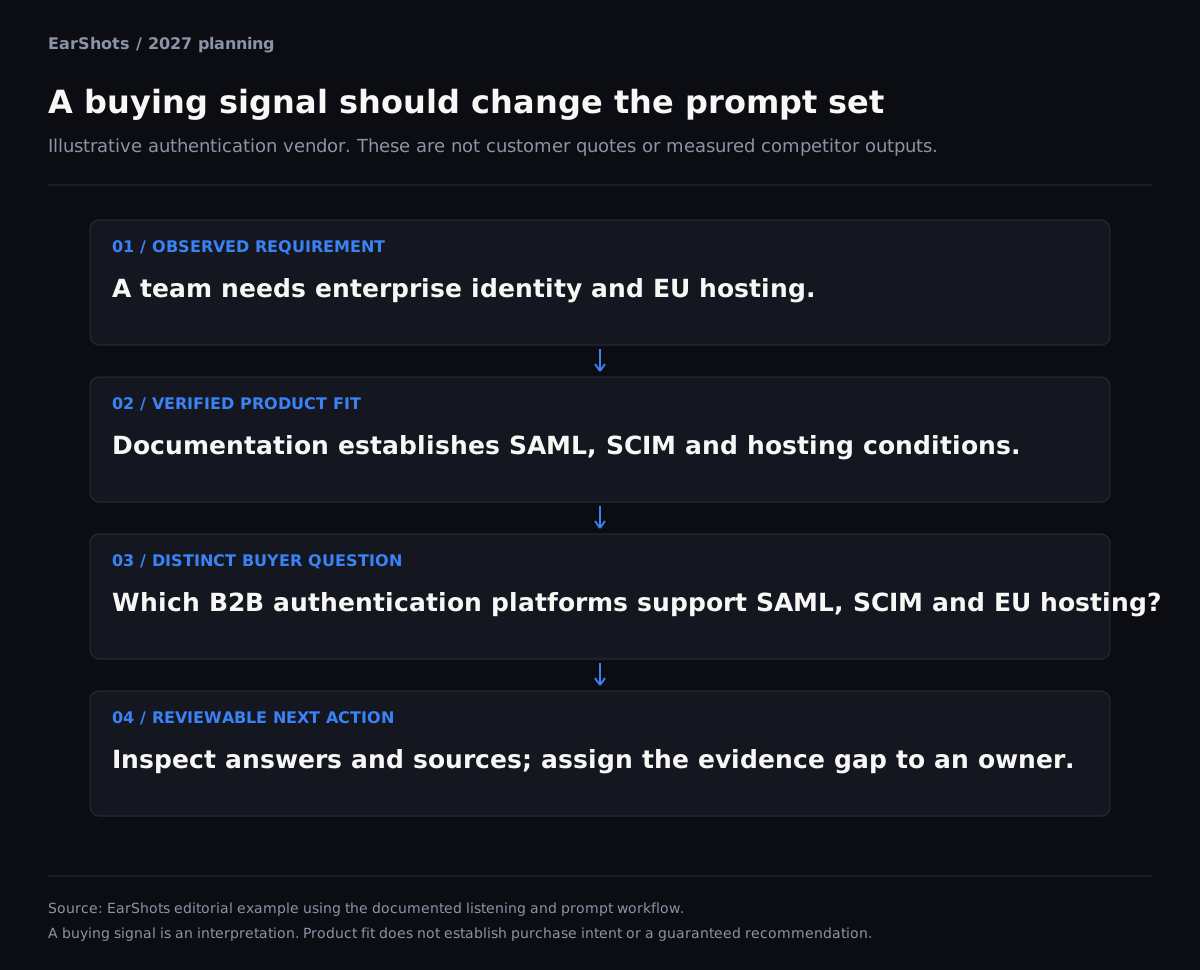
Figure 2. A buying signal informs a prompt candidate through a product-fit check. Editorial example, not a customer result.
These are editorial examples, not captured buyer quotes or outputs from a competitor's tool. A real program should attach each inferred prompt to its supporting evidence. An observed buying signal is still an interpretation; it does not establish a qualified sales opportunity or permission to contact someone.
At scale, the objective is to group recurring needs into useful themes while retaining the original sources. Rewording the same question hundreds of times creates tracking cost without necessarily adding a new decision to evaluate.
That is what we mean by prompts you should compete to win: questions where a relevant buyer has a real need, your product has a substantiated fit, and your team can improve the evidence available to answer engines. It is a prioritization standard, not a guarantee of a recommendation.
Context Buzz brings human and agent implementation evidence into AEO research
Context Buzz reads relevant public GitHub activity and groups it by adoption, integration, extension, operation, migration and exploration. It labels blockers separately and preserves links to the original evidence. Code, package names, error messages and URLs retain their technical meaning. [2]
For an AEO program, those details can reveal a question that a broad market description would omit:
- A repeated edge-runtime blocker suggests a compatibility question.
- A new integration example suggests a stack-fit question.
- Migration friction suggests an evaluation or adoption question.
- A recurring configuration error suggests an implementation guide or documentation correction.
Context Buzz supplies technical evidence for this research. The shared listening and prompt workflows can use relevant conversations to infer and organize candidate questions. Do not assume that every Context Buzz entry is automatically tracked or that an inferred question was typed verbatim into an AI assistant.
This is a practical advantage of building AEO beside technical listening: the team can investigate what people are attempting, rather than relying entirely on how a category is described.
Human and agent activity answer different questions
A person may describe a purchase requirement. A coding agent may expose an outdated installation instruction or choose an incompatible library. Both can matter, but they provide different evidence.
EarShots' Agent Signal focuses on observable public coding-agent activity and links readings to their sources. Its documented authorship checks use known agent accounts or explicit output markers; a branch name alone is insufficient. [9]
Use the distinction when researching prompts. “Which library should we choose?” tests discovery. “Can an agent install and use the current SDK correctly?” tests an adoption path. Agent-attributed activity is not a census of all agent behavior, and an agent's choice is not itself a purchase.
Turn observed agent actions into questions worth winning
An agent's actions can expose an evaluation or implementation question a marketing keyword list misses. An SDK choice or failed setup is evidence worth investigating. EarShots brings observable coding-agent activity into the same research process as human questions and product documentation. Your team can use those actions to generate prompt candidates, inspect the answers and decide what needs to change. [1] [9]
| Observed action | Question to investigate | Prompt candidate | Useful improvement |
|---|---|---|---|
| An agent chooses another SDK for an edge-runtime project | Which compatibility requirement influenced the choice? | Which SDKs support this edge runtime and deployment model? | Clarify supported runtimes and publish a verified integration example. |
| An agent uses a deprecated setup option | Which current or older instruction could explain the attempt? | How do I configure the current SDK version for this integration? | Correct conflicting README/setup guidance and retest the task. |
| An agent's migration attempt produces a repeated error | Which migration prerequisite or breaking change is missing? | What must change when migrating this integration to the current major version? | Add a sourced migration explanation and verification step. |
These examples illustrate the reasoning, not captured customer results. Retain the public artifact and check its technical conditions; an observed action does not reveal the agent's private reasoning. The resulting prompt is a research question your team can review.
For the edge-runtime case, a useful AEO program does three things: tests whether AI recommends suitable options, checks whether it describes your product accurately, and improves the evidence or instructions behind an incomplete answer. That connects visibility with the ability to complete the task.
Fresher prompts should reflect what changed in the business
A newly generated prompt can still describe an old market. Useful freshness comes from current source evidence and current product facts.
EarShots' documentation describes prompt research from relevant dated posts and documentation, with noisy and estimated-date material excluded from that conversation workflow. This gives a team a basis for reviewing new questions as the product and its users change. [1]
For example, a release that adds an integration creates a reason to review integration prompts. A competitor's changed limit may justify a new comparison question. Several independent reports of the same setup difficulty may justify an adoption-focused question and an investigation.
Keep a stable core of prompts for trend measurement and a separate set for emerging questions. Record additions, removals and wording changes. Otherwise, a visibility score can change because the evaluation set changed rather than because answer quality improved.
Our argument for fresher prompts is therefore specific: connect ongoing technical intelligence with prompt review. This article does not establish a measured recency or performance advantage over every competing platform.
Knowledge Hub keeps the program aligned with the product
The Knowledge Hub holds business context such as ideal customers, objectives, capabilities, voice, guardrails and namesake rules. It gives EarShots a shared basis for assessing relevance and preparing work. Its documented workflow retains versions and distinguishes extracted candidates from confirmed knowledge. [10]
That matters when the same term could describe your package, a competing product or something unrelated. It also matters when a capability is conditional: a feature may require a specific plan or deployment model.
For a cloud database, “encrypted” does not answer whether the customer controls the keys or where the data is hosted. Store the actual supported conditions so a comparison preserves what matters to a security reviewer.
Shared context also helps maintain continuity across people and agents. A researcher, developer marketer and connected agent should not work from three contradictory descriptions of the same product.
Parametric alignment: prepare the knowledge models may learn
Parametric alignment, as we use the term here, means improving how accurately a company's public knowledge describes its product, use cases and limitations, with future model learning as one objective. It is an editorial strategy, not a standardized ranking factor or a claim that EarShots directly trains frontier models.
A large language model (LLM) can use knowledge learned into its parameters during training. It can also receive information from search, retrieved documents and tools while answering. The foundational retrieval-augmented generation research distinguishes these parametric and non-parametric sources of knowledge. [32]
That distinction changes the AEO program you build. A model may retain an outdated description of your product while a live search finds the current documentation. A coding agent may discover the correct package but fail because its setup instructions are incomplete. Each problem needs a different intervention.
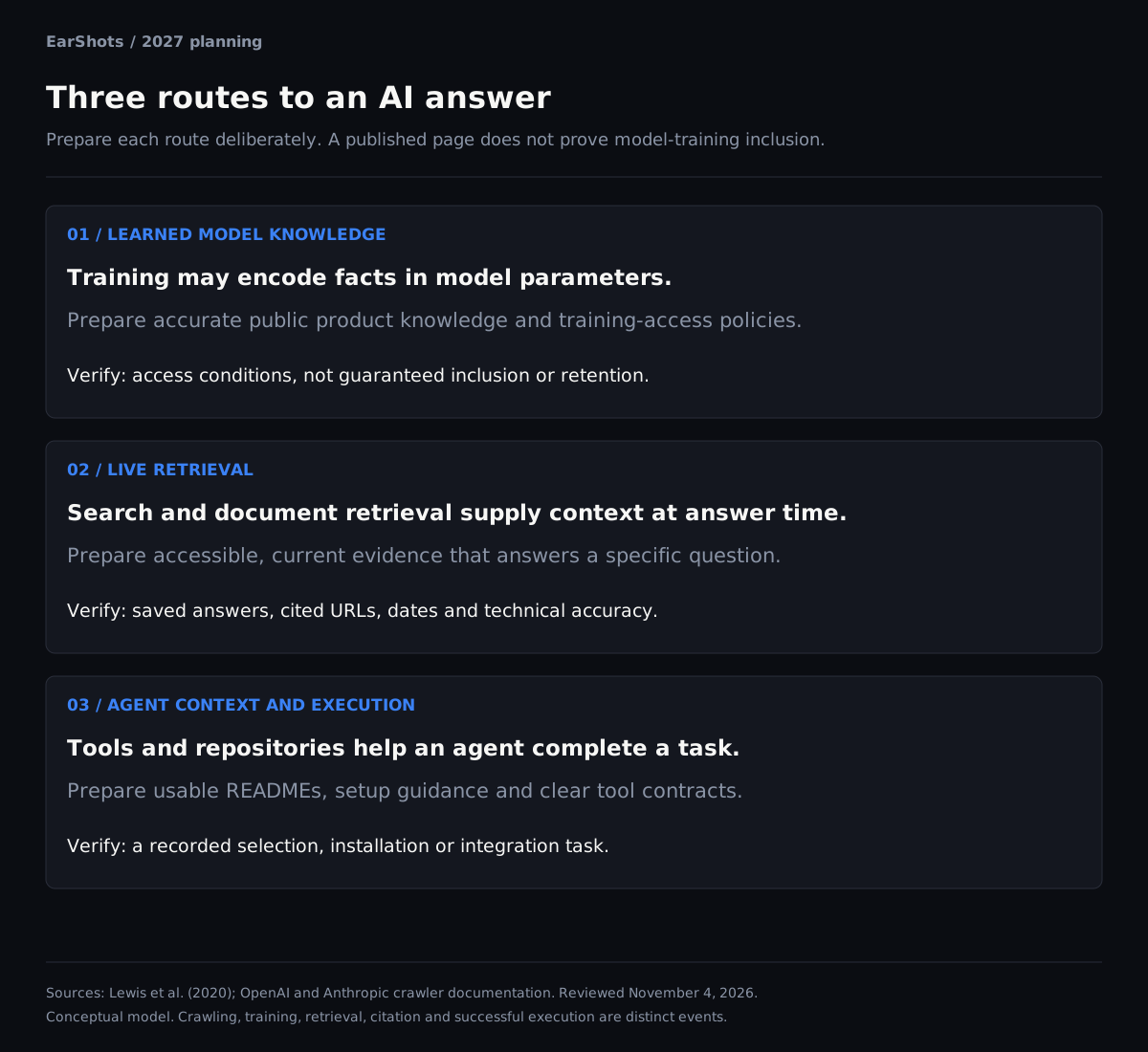
Figure 3. Training, retrieval and tool use are distinct routes. Publishing or permitting a crawl does not establish that a model learned the material.
| Route | What your team can prepare | What the evidence can establish |
|---|---|---|
| Parametric knowledge | Accurate public product descriptions, documented capabilities, version history and useful third-party coverage; deliberate training-crawler permissions | Provider policy and crawl observations can establish access conditions. They do not prove training-set inclusion, retention or future recommendations. |
| Live search and retrieval | Accessible pages that answer the question, supported comparisons, clear source links and current documentation | Saved answers and cited URLs show what a particular run retrieved or cited. |
| Agent context and execution | Usable READMEs, verified setup instructions, clear application programming interface (API) and tool contracts and authenticated context where appropriate | A recorded task can show whether an agent selected, installed or used the product correctly under tested conditions. |
Training access is a separate decision from search access
OpenAI documents separate controls for GPTBot, which crawls material that may be used for training, and OAI-SearchBot, which supports search. Anthropic distinguishes ClaudeBot for potential training material, Claude-SearchBot for search and Claude-User for user-requested retrieval. A team can make different choices for those uses. [33] [34]
Allowing a training crawler creates a possible access path. It does not submit your company to a guaranteed training queue, update an already deployed model or reserve a recommendation. Providers control collection, filtering and model development. A brand mention without a source also does not prove where the model learned it.
EarShots prepares the evidence and content work a company can control. Listening reveals misclassification, buying requirements and implementation failures. Knowledge Hub establishes the supported product facts. Prompt research identifies the questions to evaluate. Campaigns turn those findings into reviewable material. Together, those capabilities support a long-term public knowledge strategy alongside measurable retrieval and adoption work. [1] [3] [10]
Turn AEO research into READMEs, site improvements and citations
A serious technical AEO program should improve the material behind the answer. Adding more prompts to a dashboard cannot correct an ambiguous package description, an unsupported comparison or a missing deployment condition.
Improve the README an agent or developer actually uses
GitHub describes a README as a place to explain what a project does, why it is useful and how to get started. Those are also practical questions an agent must resolve when evaluating a repository. [38]
Use EarShots evidence to prioritize a focused change:
- Identity: make the product, package and supported use case explicit.
- Setup: check prerequisites, supported versions and a minimal working example.
- Constraints: state authentication, hosting, licensing and deployment limitations where relevant.
- Verification: show the documented expected result and link to current troubleshooting guidance.
If an agent follows the README and fails at authentication, check whether the example explains the required credentials and permissions. Have an engineer verify the corrected path, then repeat the task.
EarShots supplies evidence and agent-accessible context for that work. A connected coding agent can use it while preparing a repository patch in its authorized environment. This is distinct from an EarShots feature that automatically edits every customer's repository.
Prepare a coherent set of website improvements
EarShots' campaign workflow can prepare a strategy brief, a documentation cluster, a comparison article and a social distribution kit. The documented preparation process checks readiness and retains staged review. Campaign material is a draft to validate and publish through your team's workflow. [3]
For the authentication example, the useful set might include a verified identity-integration guide, a page explaining hosting conditions and a comparison that preserves the difference between SAML and SCIM. Each asset answers a distinct evaluation question. The campaign should retain the target prompt and supporting sources so reviewers can see why it exists.
That creates a practical connection between product marketing, developer relations and engineering: the buying requirement determines the work; the documentation establishes what can be claimed.
Work on the third-party sources engines already cite
Owned documentation is one source of product knowledge. Independent comparisons, technical reviews and other publishers' articles can also appear among the sources an answer engine cites.
Ears Cite is EarShots' managed citation outreach offering. It targets articles already cited for selected prompts and asks their authors to include the product where it fits. The published service model includes a product-fit statement and a budget for publisher payouts; authors decide whether to accept. Confirm availability, service terms and scope with EarShots. This managed service is separate from a campaign draft or an agent-tool preview. [35]
Paid placement is not independent endorsement. Keep commercial relationships disclosed where applicable, and qualify compensated links; Google documents rel="sponsored" for paid placements. An article inclusion, an AI citation and model-training inclusion are three different outcomes. [39]
The strategic value is a connected program: identify the question, improve your own evidence, investigate the sources engines use and measure what changed. Neither outreach nor publication guarantees a future AI recommendation.
AEO for devtools: measure discovery through successful implementation
AEO for devtools needs to cover the decisions developers make while selecting, integrating and operating a tool. A category recommendation is only one part of that path. APIs and SDKs also need accurate implementation guidance.
Useful prompt families include:
| Query family | Illustrative prompt | Evidence worth improving |
|---|---|---|
| Runtime compatibility | Which browser-testing tools support our continuous integration (CI) runners? | Supported operating systems, containers and limitations |
| Stack fit | Which feature-flag tools support our framework and self-hosted deployment? | Framework integrations and deployment requirements |
| Migration | What changes when upgrading this database SDK to the current major version? | Breaking changes and versioned migration instructions |
| Operations | How do we debug slow CI builds without leaking secrets in logs? | Diagnostic steps, redaction and operational guidance |
These are research starting points, not a claim about their search volume. Validate the wording against your documentation, support questions, relevant public activity and buyer conversations.
EarShots is a strong fit when the same team needs to connect developer listening with AI search research and adoption work. A GitHub blocker can become evidence for a prompt, a documentation task or a product investigation. The correct outcome may be an implementation fix rather than another marketing article.
AEO for AI companies: preserve the conditions behind the claim
AEO for AI companies should distinguish product categories and the conditions under which a capability works. Agent frameworks, document parsing APIs, retrieval systems, evaluation tools and model providers solve different problems.
Useful starting terms include agent memory, retrieval-augmented generation (RAG), hybrid retrieval, document extraction, evaluation datasets, tool authentication, latency and deployment. Add the qualifiers that change the buyer's decision.
For example:
- “Which document parsing APIs preserve tables in scanned financial documents?”
- “How should we evaluate retrieval quality before changing our RAG pipeline?”
- “Which agent memory systems support tenant isolation and deletion?”
- “What should we test before deploying a remote Model Context Protocol (MCP) server?”
Judge answers against a documented task and success criteria. OpenAI's evaluation guidance recommends representative datasets and domain-specific evidence. Anthropic's 2026 guidance distinguishes what an agent says it completed from the outcome that actually occurred. Those principles are useful for evaluating technical AI answers, too. [11] [12]
EarShots helps bring product and audience context into this research. Your subject-matter experts still need to verify technical claims, benchmarks and implementation advice. An answer that mentions your product while overstating its capabilities is a problem to correct.
AEO for B2B SaaS: cover the buying committee and the adoption path
AEO for B2B SaaS needs to account for several people evaluating the same product. The end user, engineering team, administrator, security reviewer and budget owner may ask different questions.
| Buyer or user | Illustrative question | Outcome to investigate |
|---|---|---|
| Product or operations lead | Which platforms fit our approval workflow and existing systems? | Qualified evaluation |
| Engineering | How does the webhook retry model handle duplicate events? | Successful integration |
| IT administrator | Does the product support our identity and provisioning requirements? | Administrative readiness |
| Security reviewer | Where is data processed, and which controls can we verify? | Completion of security review |
| Finance or procurement | What changes the total cost as usage grows? | Commercial fit |
Broad category terms remain useful for discovery. They should sit beside integration, pricing, security, migration and implementation questions, rather than determine the entire program.
EarShots' specialization is especially relevant to SaaS companies with technical evaluation cycles and observable developer activity. A business with little public technical discussion will have less Context Buzz evidence and should place more weight on documentation, confirmed business context and its own customer research.
Top AEO platforms: seven options to evaluate for 2027
Compare how each platform helps your product get found and recommended. The table shows what each offers and when EarShots' focus on technical buyers, developers and agents is a reason to choose it.
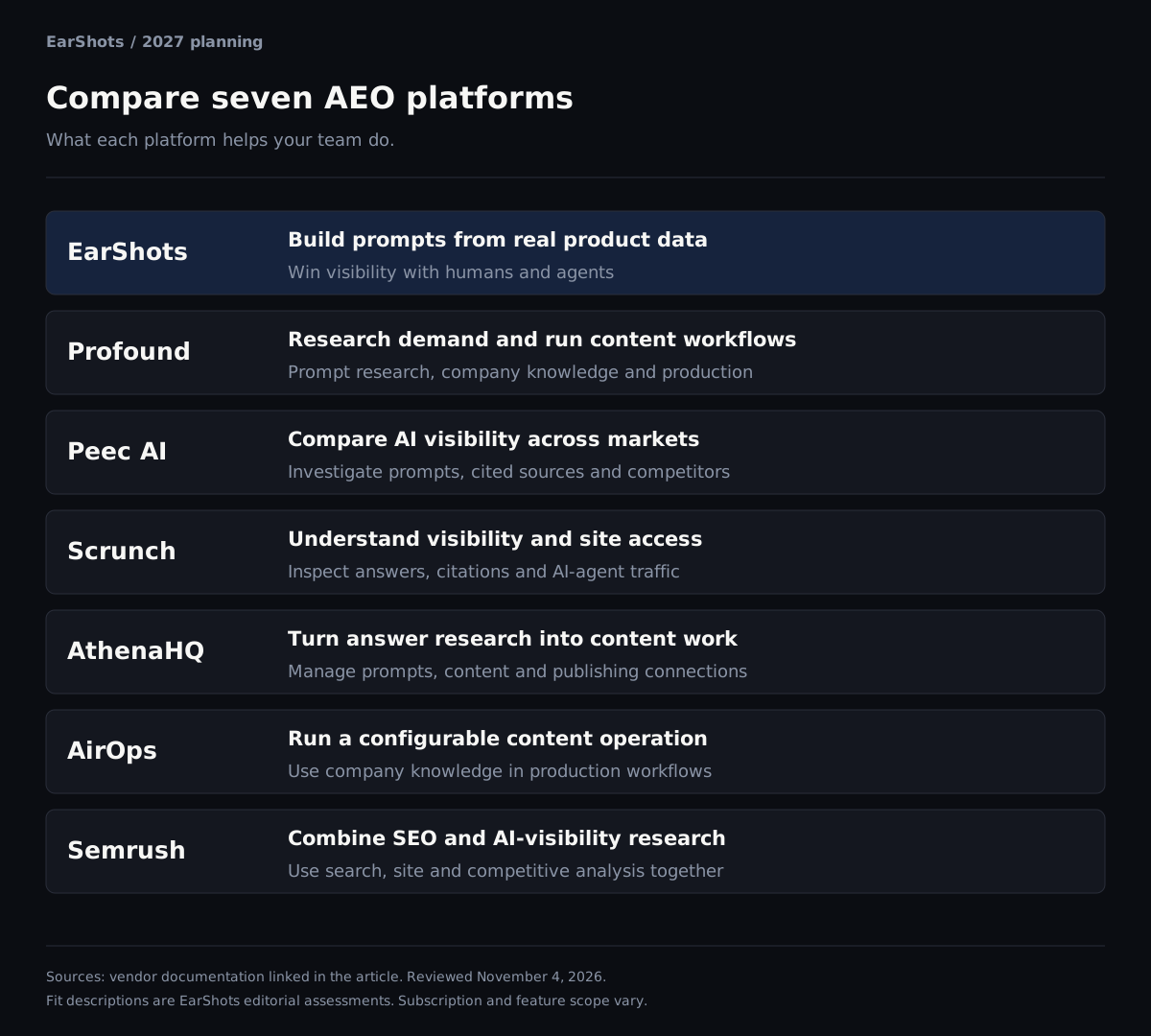
Seven-platform shortlist. The rows describe fit, not a measured ranking.
| Platform | What it helps your team do | When to choose EarShots |
|---|---|---|
| EarShots | Turn buyer questions and coding-agent actions into prompts, check how AI recommends your product, and improve the documentation and content behind those answers. [1] [3] [35] | You want to find the questions that affect a technical purchase and help people and agents use your product successfully. |
| Profound | Research prompt demand, inspect AI answers and run marketing/content workflows with business context. [7] [8] [13] | You want public implementation evidence and ongoing technical listening to help determine which questions deserve work. |
| Peec AI | Compare visibility across markets, investigate cited sources and organize prompt research using company profiles. [6] [14] [15] | You need buying requirements and developer blockers to inform the prompt set alongside brand and market research. |
| Scrunch | Connect AI visibility with site analysis, cited sources and agent traffic. [16] [17] | Your next decision depends on how people and coding agents are trying to use the product. |
| AthenaHQ | Move from visibility and citation research into prompt, content and publishing work. [18] | You want content priorities to begin with technical buyer needs, product facts and observed implementation problems. |
| AirOps | Run content production using company knowledge, playbooks and configurable workflows. [19] [20] | You need technical listening and adoption research connected with prompt selection and the work it generates. |
| Semrush | Research AI visibility alongside SEO, site checks and competitive search analysis. [21] | You want a program organized around a technical product's buyers, users and integration path. |
EarShots versus Peec AI
Peec is not limited to uploading prompts and reading a dashboard. Its current documentation includes persona and market setup, editable business context, source analysis and write-enabled MCP tools. [6] [14] [15]
The reason to choose EarShots is the technical intelligence you want informing the program: relevant conversations, public implementation evidence, coding-agent activity and confirmed product knowledge. Test that difference with your own buying-signal and blocker examples. Compare the resulting prompt rationale and proposed actions, not just how many suggestions each system returns.
EarShots versus Profound: choose the intelligence your program runs on
Choose EarShots to help more people and agents find, choose and use your product. We build prompts from real buying questions, developer conversations and observed agent actions, then help you improve the content those audiences rely on.
Profound documents prompt-demand research, persistent business context, configurable agents and content production. Its Agents page includes research, content refresh and CMS publication with approvals. [7] [8] [13]
EarShots' case starts with the technical evidence entering the program. Context Buzz contributes public GitHub usage and blocker evidence. Agent Signal adds observable coding-agent activity. Knowledge Hub supplies confirmed product and business context. Those inputs help your team identify which questions deserve attention before expanding the prompt set or producing a campaign. [2] [9] [10]
| What your team needs | How EarShots helps | What to test with Profound |
|---|---|---|
| Discover questions worth winning | Bring technical listening, product knowledge and buying requirements into prompt research. | How would its prompt-demand research and your supplied sources capture the same implementation-specific requirement? |
| Keep context current | Review new public usage, blockers and agent activity alongside confirmed product facts. | Show how a new buyer requirement reaches Context Manager and changes the next research task. |
| Improve technical assets | Use source evidence for README changes and reviewable documentation and comparison campaigns. | Ask it to turn the same version-specific blocker into a technically supported documentation change. |
| Develop third-party coverage | Evaluate Ears Cite as a separate managed outreach service tied to cited articles and selected prompts. | Ask who researches and contacts the publishers already cited for your chosen questions. |
| Operate through agents | Use the command-line interface (CLI) and MCP tools, with REST reads for reporting. | Ask an agent to complete the same research-to-draft task using its documented MCP/API tools. |
Profound may suit a marketing organization that prioritizes broad demand research and configurable content operations. EarShots fits a program where technical evaluation and developer adoption determine what to research and improve.
Run a proof of work with the same input: one real buyer requirement, one GitHub blocker and one answer that misstates your product. Ask each vendor to produce the prompt rationale, source evidence, proposed asset change and a way to verify the result. Count the manual research and integration work required. Use the result to compare technical fit and operating effort.
EarShots versus Scrunch
Scrunch connects answer visibility and citations with site and agent-traffic analysis. Choose it when understanding how AI systems access your site is central to the program. [16] [17]
Choose EarShots when the missing explanation is in the product's use: a buyer's deployment requirement, a failed setup or an agent using an outdated example. Those findings can determine the prompt to track and the content or documentation to improve. [1] [2]
EarShots versus AthenaHQ
AthenaHQ connects visibility research with prompt management, content work and publishing integrations. Choose it when those production and publishing connections define your workflow. [18]
EarShots puts technical conversations and confirmed product facts into the research process. Choose it when a content brief must explain the actual integration, limitation or migration decision behind a buyer's question. [1] [10]
EarShots versus AirOps
AirOps supports configurable content workflows backed by company knowledge and playbooks. It fits a team building a content operation with its own research and production process. [19] [20]
EarShots is focused on finding the technical need that justifies the work: what a user cannot complete, what a buyer requires and what an AI answer gets wrong. The same evidence can inform prompt research, a documentation task and a reviewed campaign. [1] [3]
EarShots versus Semrush
Semrush fits teams that want AI-visibility research alongside their existing search engine optimization work, competitive analysis and site checks. [21]
EarShots focuses on the technical evaluation path after discovery as well as the questions that lead to it. Choose it when understanding a prospective user's stack, deployment conditions and implementation blockers should shape the AEO program. [1] [2]
Agentic AEO platforms: compare the work an agent can actually do
An agent interface matters when it supports real work. Inspect three things: the evidence an agent can read, the actions it can prepare or execute, and the controls around those actions.
Anthropic distinguishes predefined workflows from agents that direct their own tool use. Both can be useful; greater autonomy is not itself proof of better results. [22]
EarShots exposes a CLI, an MCP server and a scoped REST API. They serve related but different jobs. [3] [23] [24]
| Platform | REST API | MCP | CLI | What you can do |
|---|---|---|---|---|
| EarShots | Yes | Yes | Yes | Use MCP or the CLI to work with Prompt Planner priorities, add and track prompts, inspect AI answers and citations, research human and agent activity, and prepare campaigns. Use the REST API to read saved research. [3] [23] [24] |
| Profound | Yes | Yes | Not verified | Read answers, work with company knowledge, manage prompts and run supported agent operations. [25] [26] |
| Peec AI | Yes | Yes | Not verified | Analyze visibility and sources, manage prompts and use enabled content tools; permissions apply. [15] [27] |
| Scrunch | Yes | Yes | Not verified | Read answer/citation data and manage configuration. Pricing lists the Enterprise Data API separately. [16] [28] |
| AthenaHQ | Yes | Yes | Not verified | Documented actions include prompt, content and brand-fact work, subject to account permissions. [18] |
| AirOps | Yes | Yes | Not verified | MCP includes analytics, context, knowledge retrieval and approved workflow operations. [19] [29] |
| Semrush | Yes | Yes | Not verified | Platform API/MCP access is available; this review did not establish access to every AI Visibility Toolkit report. [30] |
“Not verified” means a vendor-owned CLI was not established in the sources reviewed. A terminal client using MCP is a different interface.
EarShots is not the only AEO product with a CLI. Outside this seven-platform shortlist, Aeolo documents terminal commands for visibility, context and content work; aeo.js offers command-line site checks and file generation. These products have different scopes. EarShots' argument is the technical intelligence and actions connected through its interfaces, not ownership of the CLI category. [36] [37]
What EarShots' CLI, MCP and API make possible
Use the CLI to investigate AI recommendations from your terminal. After signing in, list your workspace's prompts in Prompt Planner score order, then read the saved answers and cited URLs for a question you want to improve. [23]
earshots call aeo_get_prompt_universe '{"sort_by":"prompt_score","limit":10}' --json
earshots call aeo_get_prompt_answers '{"prompt_id":"PROMPT_ID","include_full_text":true}' --json
Choose a row with status: tracked and replace PROMPT_ID with its prompt_id. The second command shows saved answers, brand mentions and cited sources. For example, if an answer incorrectly says your SDK requires a paid plan, compare its sources with your current pricing and setup documentation. Correct the outdated page, then check a later answer for the same question. These commands read existing results; they do not run a new evaluation. To target another workspace, include its workspace_id in each JSON argument.
Use MCP when a compatible assistant should reason over live workspace evidence. EarShots documents tools for Context Buzz, Knowledge Hub, prompt opportunities and campaign preparation. A campaign dry run checks readiness before work is queued; later campaign stages retain review requirements. [3]
An illustrative instruction for your connected agent is:
Review recent agent-attributed activity. Find a task where an agent chose our product, chose an alternative or got stuck. Link the source and check the relevant capability against our confirmed documentation. Mark the reason unknown if the source does not explain it. Propose an AEO question that would help another agent make that decision, check whether we already track it, and inspect any saved answers and citations. Return the proposed prompt and content correction for review.
Ask an agent to build a content calendar from agent findings
Use the findings to decide what your team should explain next. A content calendar for agent discovery should include material a coding agent can use: READMEs, setup instructions, integration examples, migration guides and comparisons that state the product's limits.
Replace the two bracketed fields in this instruction:
Build a four-week content calendar for [Product X] and [Integration or use case Y], using our confirmed product context and recent observed coding-agent activity. Find recurring package choices, failed setup steps, migration attempts and implementation questions. Compare those findings with our existing documentation and prompt universe. Propose the missing material that would help an agent choose and use our product correctly. For each item, include the source links and dates, the agent's task, the question to answer, the proposed README or page change, the product facts to verify, an owner and a success measure. Explain why each item deserves priority and flag ideas without enough evidence. Return a draft calendar for review; do not activate tracking, queue paid work or publish content.
A useful calendar names the task each page should enable. This illustrative document-parsing API plan shows four distinct information gaps:
| Week | Finding to verify | Material to prepare | Task the material should enable |
|---|---|---|---|
| 1 | Agents construct an invalid file-upload request | A verified upload quickstart | Upload a sample document and inspect the response |
| 2 | An agent assumes every scanned PDF is supported | A format and extraction-limit guide | Decide whether the API fits the actual document |
| 3 | Failed requests lead to repeated, potentially duplicate work | Retry and idempotency guidance based on the API's contract | Recover from a failure without repeating a completed job |
| 4 | Agents choose another API because table output is unclear | A table-extraction example with a test document | Compare the returned structure with the original table |
An engineer verifies the product facts and examples before publication. After shipping, repeat the relevant agent task and inspect the target AI answers. The calendar is useful when it closes a real information gap and makes the task easier to complete.
This is an instruction to an agent using several tools, not a claim that one EarShots tool performs the whole task automatically.
Use the REST API to read stored intelligence into your own reporting or operational systems. Documented resources include Context Buzz, confirmed knowledge, AEO rollups, competitor evidence and saved campaign stages. The API's AEO read returns stored counts; it does not run a new answer or generate content. [24]
curl --location --fail-with-body \
  --header "Authorization: Bearer $EARSHOTS_API_KEY" \
  'https://earshots.dev/api/v1/aeo?limit=25'
The same source evidence can inform a terminal investigation, an assistant-generated brief and the team's reporting. Each interface retains its documented permissions.
From listening to action, adoption and ROI
Find where people and agents get stuck, fix the problem, then check whether more evaluators complete setup and become paying customers. Use EarShots for listening, prompt research and campaigns; use your product and billing records to measure adoption and revenue.
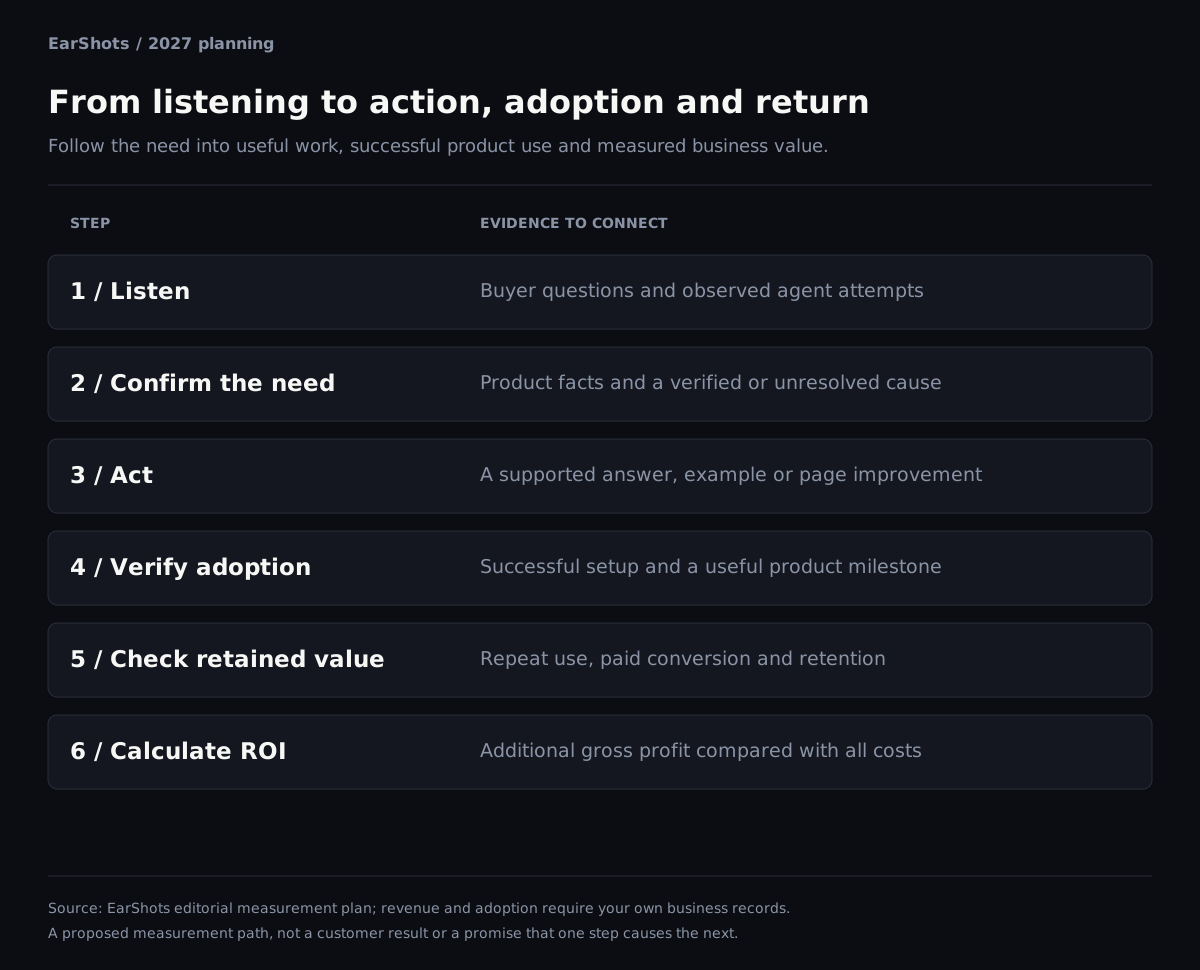
An outcome and measurement plan. Each step needs its own evidence; the arrows do not represent guaranteed conversion.
Follow one need through the whole program
Consider an illustrative data-import tool. Developers cannot get a sample CSV into their application because the field-mapping instructions are unclear. Public questions and failed agent attempts expose the same missing explanation.
The team publishes a verified mapping example, updates the quickstart and answers the original question. It also tracks whether AI can explain the import correctly. An engineer checks that the revised path imports the sample data.
The next questions concern behavior: do more evaluators complete their first import, do they keep importing useful data, and do suitable accounts become paying customers? Those are the outcomes that can support a financial case.
| Step | What the team does | Evidence to record | What moves the business forward |
|---|---|---|---|
| 1. Listen | Find buyer questions and observable agent attempts. | Original source, date, task, runtime and reported error. | A real need to investigate. |
| 2. Confirm the need | Check the product facts and reproduce the problem where possible. | Supported conditions, affected versions and verified or unresolved cause. | A specific improvement the product can support. |
| 3. Act | Answer the question, fix the example or publish the missing guide; track the related AI question. | Reviewed work, publication date, changed page and target prompt. | An evaluator has a clearer path to a correct choice or working integration. |
| 4. Verify adoption | Test whether people and agents can now complete the task. | Successful setup or first useful API call; relevant page visits, trials and activation events. | More suitable evaluators reach a defined product milestone. |
| 5. Check retained value | Follow the activated cohort into repeat use and paid accounts. | Continued product usage, paid conversion and retention for the stated period. | Use that produces revenue or another verified business benefit. |
| 6. Calculate ROI | Compare additional gross profit attributed to the work with its total cost. | Customer/billing records, delivery costs, software spend and team effort. | A defensible estimate of return and a decision about what to repeat. |
Keep AI visibility connected to this path
Track the relevant prompts before and after the change. Check whether answers recommend a suitable product, describe its limitations correctly and cite material that helps the evaluator. Then inspect whether relevant visits and evaluations reach the adoption milestone.
Bing distinguishes AI citations from clicks; its grounding-query groups are retrieval phrases rather than exact user prompts. Treat answer visibility, traffic and activation as separate measurements. [4] [31]
An answer may influence a buyer who never clicks its citation. A buyer's voluntary explanation of how they researched the product can add context to analytics, while remaining a reported experience rather than complete attribution.
Connect the question to the signup and sale
Keep the original finding, work item, changed page and target prompt connected. Use page or campaign identifiers in your analytics, then follow the relevant activation cohort in product and customer data. EarShots supplies listening evidence and saved research; this article's revenue analysis is a team measurement plan, not a claim that EarShots automatically attributes every sale.
Where possible, compare the changed path with a similar unchanged path or run a controlled test. A before-and-after improvement can also reflect a release, another campaign or a change in the customers arriving. State those limits when reporting the result.
Calculate the return in plain terms
ROI asks whether the additional value covers the spending. For a revenue program, use additional gross profit attributed to the work: revenue after the direct cost of delivering the product or service.
AEO ROI = (additional gross profit attributed to AEO − total AEO cost) ÷ total AEO cost.
Include software, research, content production, technical review and measurement in the cost. For example, $8,000 in additional gross profit against $5,000 of program costs produces $3,000 after those costs, or 60% ROI. This is a calculation example, not an EarShots customer result.
If you cannot isolate AEO's contribution, report the associated activations, paid conversions and cost instead of a causal ROI claim. Support savings can be measured separately through verified changes in handling time; avoid counting the same benefit twice.
The decision to scale should follow this evidence: which findings led to useful work, which changes helped people adopt the product and which adopted use produced enough value to justify the effort.
How to evaluate a platform before your 2027 budget is committed
Run a bounded pilot using your own material. The following is an example evaluation plan, not an industry benchmark.
First, establish product truth and a prompt baseline. Confirm buyer profiles, documentation, capabilities and exclusions. Include discovery, evaluation, implementation and adoption questions. Keep a stable core so later comparisons are interpretable.
Then test research quality. Give vendors a small set of recent buying signals and technical blockers. Review which new questions they propose, why they propose them and whether the supporting evidence survives. Record rejected and duplicate suggestions.
Next, test the improvement workflow. Choose a few answer gaps. Inspect the sources, assign a technical owner and prepare a comparison, example, documentation correction or campaign brief. Verify that someone can review and recover the work before anything is published.
Finally, review outcomes and operating cost. Repeat the same core prompts under recorded conditions. Compare answer quality, useful business activity and the time needed to maintain the program. Record how many relevant answers the subscription captures, which engines it covers and which tasks still need your team.
Questions technical teams ask about agentic AEO
Can generic AEO tools work for a technical company?
Yes. Several horizontal platforms document technical customers, business context and configurable workflows. The evaluation question is how much relevant intelligence and setup your team must supply, and whether the resulting prompts reflect its actual users and buyers.
Is EarShots' advantage simply automatic prompt generation?
No. Automatic generation is widely available. The reason to evaluate EarShots is the connection between confirmed product context, technical listening, buying signals, prompt research, content improvements and managed citation outreach. Judge the quality and traceability of the questions, not the generation count.
Can EarShots get our company into an LLM's training data?
EarShots helps prepare the public knowledge, technical evidence and content strategy that may be available to model providers. It does not control their training datasets or guarantee inclusion. Evaluate parametric knowledge, live retrieval and agent task success separately. [33] [34]
Does MCP access make a platform agentic?
MCP provides an interface. Assess the end-to-end task: can an agent retrieve relevant evidence, prepare a justified next step and respect the team's review process? Several platforms in this comparison document MCP support.
Will better prompts guarantee more customers?
No. Better prompt selection makes the evaluation more relevant. Results also depend on product fit, available evidence, content quality, retrieval behavior, competition and the buyer's experience after discovery. Measure those stages separately.
What does “built for technical businesses” mean in practice?
For EarShots, it means treating documentation, package and product identity, public implementation evidence, human and agent activity, technical buying requirements and agent-accessible tools as connected parts of the workflow.
Build your 2027 program around questions worth winning
Choose EarShots.dev when you want a technical AEO program grounded in what your buyers ask, how developers use your product and the actions coding agents take. We connect product knowledge and technical listening with priority prompts, source-backed campaigns and managed citation outreach. Use that foundation to improve the public knowledge, retrieved evidence and implementation guidance people and agents encounter.
Start your agentic AEO program today.
Sources
Source numbers match the citations above. Product documentation describes vendor capabilities; research findings retain their stated population and period. Sources checked November 4, 2026.
- EarShots — Prompt Universe documentation
- EarShots — Context Buzz documentation
- EarShots — MCP documentation
- Bing Webmaster Tools — AI Performance
- Google Search Central — AI features and your website
- Peec AI — Project Profile
- Profound — Introducing Context Manager in Profound September 1, 2026.
- Profound — Prompt Volumes
- EarShots — Agent Signal
- EarShots — Knowledge Hub
- OpenAI — Evaluation best practices
- Anthropic — Demystifying evals for AI agents January 2026.
- Profound — Agents
- Peec AI — Setting up your prompts
- Peec AI — MCP tools
- Scrunch — Developer documentation
- Scrunch — APIs and their operation
- AthenaHQ — Integrations
- AirOps — MCP server
- AirOps — Knowledge Bases / Memory Stores
- Semrush — AI Visibility Toolkit
- Anthropic — Building effective agents December 2024.
- EarShots — CLI documentation
- EarShots — REST API documentation
- Profound — Developer documentation index
- Profound — MCP server
- Peec AI — MCP integration
- Scrunch — Pricing and plans
- AirOps — API reference
- Semrush — MCP documentation
- Bing Webmaster Blog — Topics Portfolio beta in AI Performance October 2026.
- Lewis et al. — Retrieval-Augmented Generation for Knowledge-Intensive NLP Tasks NeurIPS 2020; revised 2021.
- OpenAI — Overview of OpenAI Crawlers
- Anthropic — Web crawlers and site-owner controls April 7, 2026.
- EarShots — Ears Cite managed citation outreach
- Aeolo — CLI
- aeo.js — CLI documentation
- GitHub Docs — About the repository README file
- Google Search Central — Qualify outbound links
- EarShots — Selected public implementation examples, reviewed November 4, 2026